Designing Trials for the Data We’ll Need Next: Dana Lewis on Participant Burden, Researcher Burden, and Consent in the AI Era

CTTI News | April 22, 2026

Topics Included: Patient Engagement

Dana Lewis is an independent researcher, a patient, and a member of the Executive Committee of the Clinical Trials Transformation Initiative (CTTI). With deep experience navigating clinical research both as a participant and as a researcher, Lewis brings a rare systems‑level perspective to how trials are designed, how data are collected, and how emerging technologies (particularly AI) are changing what is possible. In advance of CTTI’s Patient Summit, Lewis spoke with Morgan Hanger about data capture, consent, researcher assumptions, and why many trials remain anchored in outdated models.

Note: This interview has been slightly edited for brevity.


Hanger: Such a thrill to speak with you today. You’ve emphasized that trials should capture all data that participants are willing to share, particularly as AI capabilities accelerate. From your perspective, why is this so important now?

Dana Lewis: We don’t know what future technologies will enable, but what we do know is that we’re constrained by the data we collected in the past. Those constraints are often artifacts of the effort and cost involved, for both participants and researchers. Most trials are designed around a narrow endpoint and so they collect a very narrow set of data. That limits what we can answer later. Questions about titration, implementation, or real‑world use often matter deeply to patients, but the data simply aren’t there.

More data gives us more opportunities for future analysis. That’s especially critical in small populations, where patients may have very few chances to participate in trials at all. If we don’t collect these data now, we lose that opportunity.

Hanger: At the same time, the field is under pressure to simplify trials — reduce complexity, manage ballooning costs, and limit participant burden. Many stakeholders see that as directly at odds with collecting more data. How do you see that tension?

Lewis: I think the call for more data is really about recognizing that data capture has changed. We have tools for passive data collection that didn’t exist or weren’t widely available five or ten years ago.

Participants already carry phones or wearables that collect movement or other wearable data. There are apps that make meal tracking easier through photos, text, or audio. It may not be the perfect gold‑standard measurement every time, but we can get useful estimates with significantly less effort, and in many cases having less accurate data is still better than no data.

So the question becomes: are we not collecting data because it’s truly burdensome, or because we’re still thinking with an outdated understanding of what participant burden looks like? Or because the burden is for the research team? That’s why patient co‑design is essential, to honestly assess where that burden still exists and where it no longer does.

Hanger: You also introduce a concept that’s less frequently discussed: researcher burden. Can you expand on that?

Lewis: A lot of decisions about what data not to collect come from the researcher perspective, including the perceived burden of collecting, cleaning, managing, and analyzing additional data. But that burden has also changed. We often default to saying, “It’s too hard to do anything with that data,” even when patients are explicitly asking us to use it. That mindset is frequently based on technology limitations from years ago. Today, many tools make data ingestion, cleaning, and analysis significantly easier, faster, and lower cost, plus more accessible to researchers with different backgrounds and expertise areas. We absolutely should think about participant burden, but we also need to be honest about whether researcher burden is being over‑weighted in design decisions for clinical trials, especially when there is clear potential value.

Hanger: You wear so many hats, Dana. You’ve also spoken from personal experience as a trial participant about how results are communicated. What’s missing today?

Lewis: As a participant, when results are published years later, they’re almost always population‑level findings. It’s not clear whether I was a responder, a non‑responder, or how, or if, those findings apply to me at all.

There are many opportunities to return data to participants in meaningful ways. When participants receive their own data, they can better contextualize the population‑level findings and have more informed conversations with their clinicians about how the results may or may not apply to their individual situation. This is especially relevant for people with multiple conditions, where there may never be a study that perfectly matches their profile.

Hanger: We know how clinical research often relies on altruism as a motivating factor for participation. Does returning data shift that paradigm?

Lewis: It can. When participants can see and understand their own data, it adds individual value alongside collective value. That doesn’t eliminate altruism, but it strengthens the overall value proposition of participation.

Hanger: When discussions turn to maximizing data use, issues of privacy, consent, and stewardship quickly emerge. What are you hearing from patient communities?

Lewis: Patient communities are not monolithic. Even within a large category like diabetes, perspectives vary significantly. Someone with type 1 diabetes plus additional autoimmune conditions may worry about identifiability and have higher privacy concerns. Or not: someone else in that exact situation may want their data reused as broadly as possible because no one is ever going to design a study that exactly reflects them. Historically, trials tend to adopt the most conservative approach in order to protect participants and respect preferences. The intent is good, but that approach doesn’t reflect the range of patient preferences.

Hanger: You’ve proposed a layered consent model as a way to address this. What would that look like operationally?

Lewis: The first layer is consenting to participate in the trial, with clear explanation of how privacy and data are managed within that study. The second layer (separate question, one that does not affect trial participation) is whether a subset of the data can be shared or reused for future research. Participants can say yes or no. Both responses are valid.

Right now, most trials don’t explicitly ask that question about data re-use. As a result, even participants who want their data reused never have that opportunity. We could support both perspectives within the same study design if consent is structured intentionally from the start.

Hanger: Do preferences change based on the type of data being collected?

Lewis: Absolutely. Continuous glucose monitor data with timestamps may feel very different to someone than genetic data. Even for the same individual, comfort levels vary depending on the type of data and the context in which it’s collected. That nuance is important and it’s something we are capable of addressing if we design for it.

Hanger: I love the intersection of design and hope. You’ve repeatedly said that these challenges are solvable. What’s the biggest obstacle to change?

Lewis: One of the biggest obstacles to change is copy‑and‑paste study design. Too many protocols follow patterns established five or ten years ago without stopping to ask what’s possible now. We should be asking: What technology exists for passive data capture? What tools exist for cleaning and analyzing these data during the study? What infrastructure supports layered consent and clean sub‑datasets aligned with participant preferences? All of this is possible, but it requires intentionally rethinking design decisions instead of defaulting to precedent.

Hanger: As we wrap up, what’s your message to stakeholders who may feel this perspective doesn’t represent them?

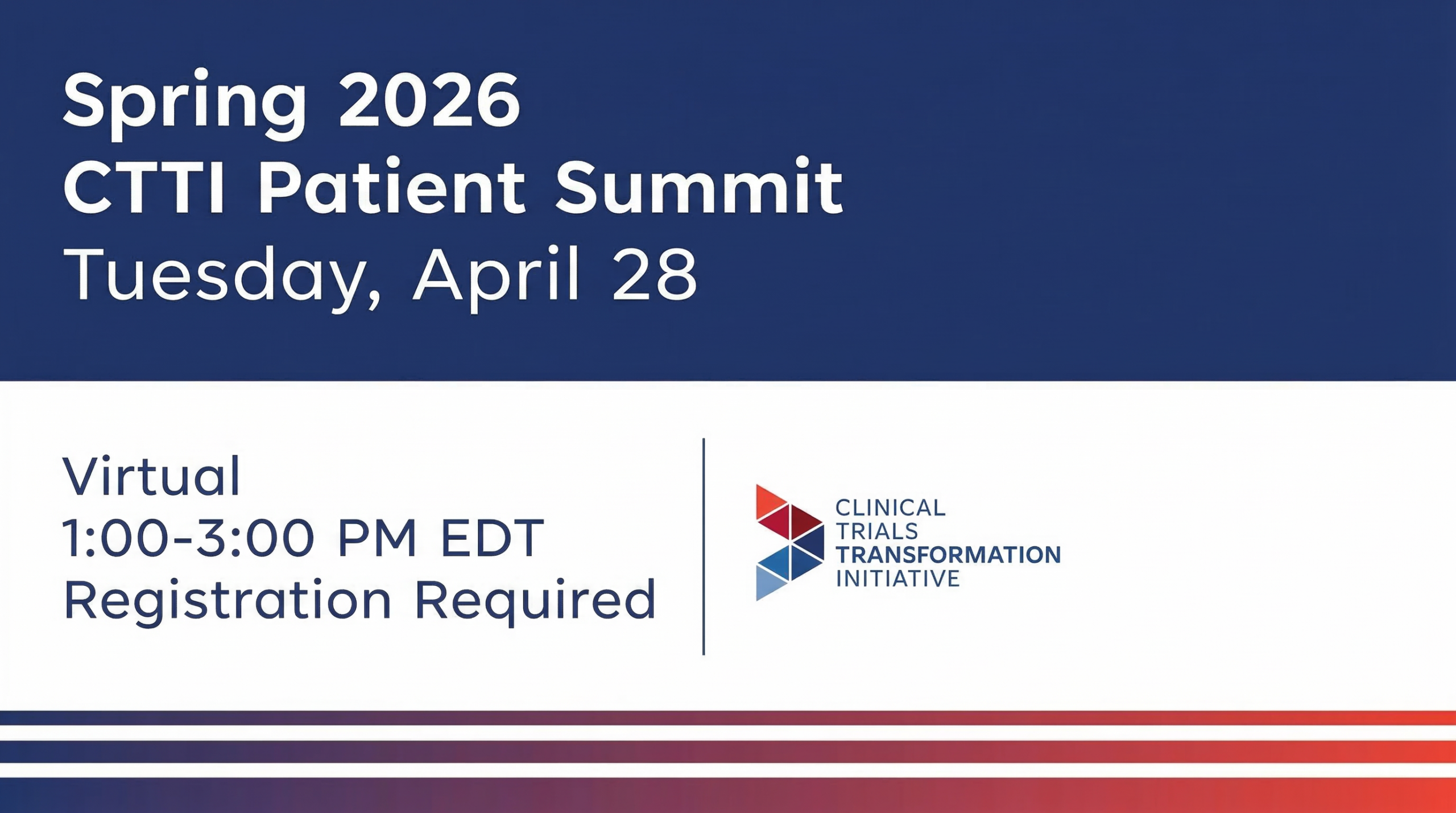
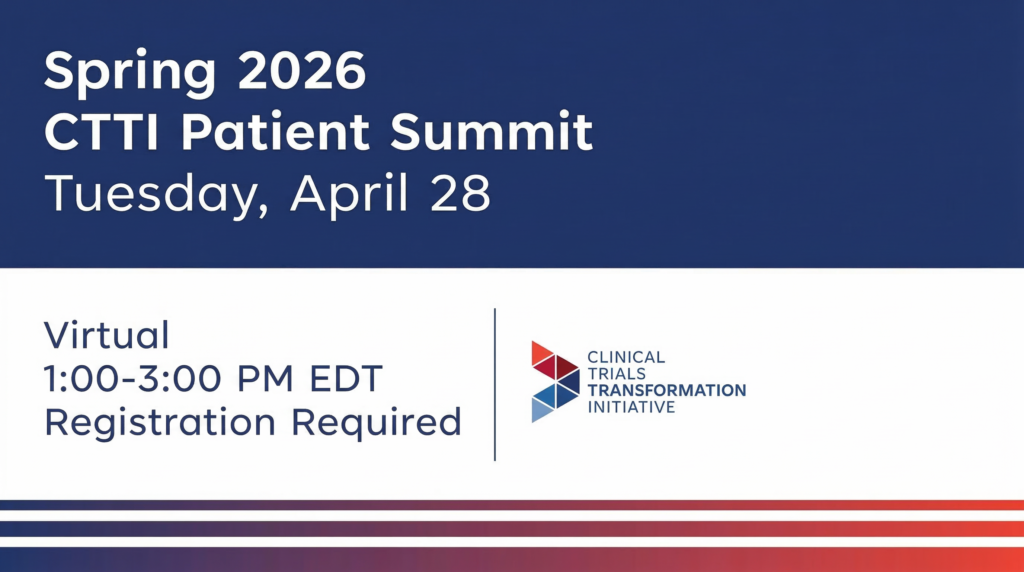
Lewis: That’s it’s an invitation to participate in this discussion at the CTTI Patient Summit on April 28, 2026, and beyond. My understanding of the range of perspectives is necessarily limited by my experiences, for example. If someone is listening and thinking, “That doesn’t reflect my experience,” that’s exactly the voices we need to hear from, so that they are represented, too.

We can only move research design forward by hearing from people with different use cases, constraints, and concerns, and working through where current approaches do and don’t apply.


The CTTI Patient Summit on April 28, 2026, brings together patients, caregivers, and patient advocates to continue these discussions. Register now to attend.

Artificial Intelligence in Drug & Biological Product Development Hybrid Public Workshop 2025

Webinars | November 4, 2025

Topics Included: Artificial Intelligence

Meeting Recordings:

Welcome & Session 1: Where Are We Now?

Session 2: Data Quality, Reliability, Representativeness, and Access in AI-Driven Drug Development

Session 3: Model Performance, Explainability, Transparency, and Interpretability in AI-Driven Drug Development

Session 4: Navigating the Future of AI in Drug Development

Discussion & Concluding Remarks

Share Your Feedback

We welcome your questions and feedback about this workshop. If you have follow-up thoughts or comments on the topics discussed, please share them using the brief form linked below. Your input will help inform future discussions and events.

FDA, CTTI Convening 2025 Hybrid Public Workshop on Artificial Intelligence in Drug & Biological Product Development

CTTI News | August 25, 2025

Topics Included: Artificial Intelligence

Registration is now open for the second Hybrid Public Workshop on Artificial Intelligence in Drug and Biological Product Development, hosted by the U.S. Food and Drug Administration in collaboration with the Clinical Trials Transformation Initiative. The event will take place on October 7, 2025, in person at The National Press Club in Washington, DC, and online via Zoom.

Join experts from across sectors for a forward-looking discussion on how artificial intelligence (AI) is transforming drug and biological product development. Building on momentum from the first workshop in 2024, this year’s event will highlight real-world breakthroughs and explore how AI is advancing the safety, efficacy, and quality of drugs and biological products.

Speakers will address best practices, cross-disciplinary collaboration, and practical strategies to improve data quality, reduce bias, and increase transparency in AI models. Attendees will gain insights into responsible applications of AI in clinical research and to support regulatory decisions, along with opportunities to support innovation across the field.

The workshop will run from 9:00 a.m. to 5:00 p.m. Eastern Daylight Time. Attendance is free and open to the public.

Register now to be part of this important conversation on the future of AI in medical product development.

Maximally Leveraging All Available Data

Too often, people find participating in clinical trials not only difficult, but also unaligned with their actual needs and goals. To address this issue, we need to engage patients from the very beginning of the trial design process in order to ensure they feel empowered to participate in research and understand the impact it can have on people’s health. A more patient-centered and easily accessible approach can go a long way in making people feel less like human subjects and more like active, involved partners in the research process. In CTTI’s 2030 vision for clinical trials:

  • Patients and patient organizations are fully integrated in the design and governance of clinical trials, helping to ensure the relevance of the research questions and completeness of outcomes.
  • When possible, individuals are involved in clinical trials without going to designated clinical sites to enroll or participate.
  • Home trials, hybrid trials, and technologies are maximally used to allow all potential participants to take part regardless of geography and mobility and to maximize efficiency and minimize costs.
  • Every potential participant is aware of clinical trials relevant to them.
  • Enrolled clinical trial participants reflect the diversity of the population expected to use the medical product.

News

    Case Study

      Navigating the New Normal: CTTI Announces Playbook on Best Practices for Conducting Trials During COVID-19


      As the world adapts to the COVID-19 pandemic, CTTI is leading the charge to help the clinical trials ecosystem evolve and move forward. Since March 2020, CTTI conducted a series of initiatives to help the research community successfully navigate the challenges associated with adjusting trials that were underway when the pandemic hit. These initiatives and resulting best practices are captured in a new playbook, Best Practices for Conducting Trials During the COVID-19 Pandemic.

      CTTI gathered experiences and learnings from across the clinical trials ecosystem via public surveys and discussions, and communicated these findings during two CTTI-hosted webinars. These efforts extrapolated best practices for conducting clinical trials with new FDA guidance on COVID-19, as well as solutions to help investigators shift to remote and virtual visits during the COVID-19 pandemic.

      Through this initial work when the pandemic first hit, CTTI identified eight essential best practices on how to conduct clinical trials during the pandemic. These key points, fully outlined in the new COVID-19 playbook, recommend that stakeholders:

      1. Keep participants informed
      2. Perform outgoing risk-benefit assessment
      3. Communicate with IRBs and regulatory authorities
      4. Adjust new study starts and enrollment based on risk
      5. Pivot to remote study visits
      6. Switch to remote monitoring
      7. Be flexible
      8. Document everything with COVID-19 tags

      The new document provides detailed information on how stakeholders can best integrate these important recommendations into their ongoing clinical trials while providing several additional resources to fully support these efforts. This comprehensive resource will help researchers adapt to the changing clinical trial landscape and continue to conduct successful studies during the pandemic.

      Advancing Clinical Trials in the Age of the COVID-19 Pandemic

      The COVID-19 pandemic has turned our world upside down. Every aspect of our ways of life are experiencing unprecedented disruptions.

      For the clinical trials community, we are seeing steep declines in patient enrollment and, in some cases, complete pauses of trials. A report from Medidata showed an 83 percent decrease in new patients entering trials in China in February 2020 compared to February 2019 and similar trends have been seen in other countries. In the first half of March this year, the U.S. has had a 62 percent decrease in new patients entering trials.

      This pandemic has thrust clinical research into the limelight like never before and – while daunting and challenging – the scientific community is answering its collective call-to-duty with impressive vigor and determination. COVID-19 is literally changing the way the world does science.

      Researchers and scientists are saying, according to the New York Times, “Never before have so many experts in so many countries focused simultaneously on a single scientific quest with so much urgency – exchanging information as it becomes available and launching clinical trials that rely on laboratories and hospitals from around the world.”

      Developing a vaccine against COVID-19 and new treatments for those infected with the novel coronavirus is of paramount importance and we applaud those efforts. We must also do what we can to advance new and ongoing clinical trials for all medical products across all diseases and therapies in the age of the coronavirus pandemic. For some patients, participation in a clinical trial may be their last chance at extending or even saving their life. We owe them that chance.

      On March 18, the U.S. Food and Drug Administration (FDA) released guidance “to provide general considerations to assist sponsors in assuring the safety of trial participants, maintaining compliance with good clinical practice (GCP), and minimizing risks to trial integrity during the COVID-19 pandemic.” The European Medicines Agency (EMA) and Medicines & Healthcare products Regulatory Agency have also released similar guidance documents.

      In response to the FDA’s new guidelines, the Clinical Trials Transformation Initiative, a leader in driving change across the clinical trials ecosystem, surveyed the research community about experiences and best practices on the conduct of clinical trials of medical products during the current COVID-19 crisis. The survey’s findings were presented along with shared experiences from a patient representative, academic medical center and independent IRB on a CTTI-hosted webinar on Mar. 31.

      The survey’s findings, along with additional learnings from the webinar, identified the following best practices for conducting clinical trials during this pandemic:

      1. Keep Participants Informed
      2. Perform Ongoing Risk-benefit Assessment
      3. Communicate with IRB/IEC and Regulatory Authorities
      4. Pause (Most) New Study Starts & Enrollment
      5. Pivot to Remote Study Visits
      6. Switch to Remote Monitoring
      7. Document all changes with COVID-19 Tag

      These best practices were released by CTTI this week as a free online resource.

      During this pandemic, the clinical trials community is rising to meet the challenge upon us. Most immediately, we must respond to the urgent public health need to prevent, diagnose and treat COVID-19 and we must seize the unprecedented opportunity to collaborate and conduct clinical trials for a vaccine against this disease in the most efficient way possible. The clinical trials enterprise can also use this experience to adopt these more collaborative and innovative approaches as routine on a wider scale moving forward. Our ultimate goal is that we will drive for change that leads to further development of medical products currently under investigation and, as a result, saves lives.

      This article was originally published by CTTI Executive Director Pamela Tenaerts on LinkedIn on 4/20/20.