Designing Trials for the Data We’ll Need Next: Dana Lewis on Participant Burden, Researcher Burden, and Consent in the AI Era

CTTI News | April 22, 2026

Topics Included: Patient Engagement

Dana Lewis is an independent researcher, a patient, and a member of the Executive Committee of the Clinical Trials Transformation Initiative (CTTI). With deep experience navigating clinical research both as a participant and as a researcher, Lewis brings a rare systems‑level perspective to how trials are designed, how data are collected, and how emerging technologies (particularly AI) are changing what is possible. In advance of CTTI’s Patient Summit, Lewis spoke with Morgan Hanger about data capture, consent, researcher assumptions, and why many trials remain anchored in outdated models.

Note: This interview has been slightly edited for brevity.


Hanger: Such a thrill to speak with you today. You’ve emphasized that trials should capture all data that participants are willing to share, particularly as AI capabilities accelerate. From your perspective, why is this so important now?

Dana Lewis: We don’t know what future technologies will enable, but what we do know is that we’re constrained by the data we collected in the past. Those constraints are often artifacts of the effort and cost involved, for both participants and researchers. Most trials are designed around a narrow endpoint and so they collect a very narrow set of data. That limits what we can answer later. Questions about titration, implementation, or real‑world use often matter deeply to patients, but the data simply aren’t there.

More data gives us more opportunities for future analysis. That’s especially critical in small populations, where patients may have very few chances to participate in trials at all. If we don’t collect these data now, we lose that opportunity.

Hanger: At the same time, the field is under pressure to simplify trials — reduce complexity, manage ballooning costs, and limit participant burden. Many stakeholders see that as directly at odds with collecting more data. How do you see that tension?

Lewis: I think the call for more data is really about recognizing that data capture has changed. We have tools for passive data collection that didn’t exist or weren’t widely available five or ten years ago.

Participants already carry phones or wearables that collect movement or other wearable data. There are apps that make meal tracking easier through photos, text, or audio. It may not be the perfect gold‑standard measurement every time, but we can get useful estimates with significantly less effort, and in many cases having less accurate data is still better than no data.

So the question becomes: are we not collecting data because it’s truly burdensome, or because we’re still thinking with an outdated understanding of what participant burden looks like? Or because the burden is for the research team? That’s why patient co‑design is essential, to honestly assess where that burden still exists and where it no longer does.

Hanger: You also introduce a concept that’s less frequently discussed: researcher burden. Can you expand on that?

Lewis: A lot of decisions about what data not to collect come from the researcher perspective, including the perceived burden of collecting, cleaning, managing, and analyzing additional data. But that burden has also changed. We often default to saying, “It’s too hard to do anything with that data,” even when patients are explicitly asking us to use it. That mindset is frequently based on technology limitations from years ago. Today, many tools make data ingestion, cleaning, and analysis significantly easier, faster, and lower cost, plus more accessible to researchers with different backgrounds and expertise areas. We absolutely should think about participant burden, but we also need to be honest about whether researcher burden is being over‑weighted in design decisions for clinical trials, especially when there is clear potential value.

Hanger: You wear so many hats, Dana. You’ve also spoken from personal experience as a trial participant about how results are communicated. What’s missing today?

Lewis: As a participant, when results are published years later, they’re almost always population‑level findings. It’s not clear whether I was a responder, a non‑responder, or how, or if, those findings apply to me at all.

There are many opportunities to return data to participants in meaningful ways. When participants receive their own data, they can better contextualize the population‑level findings and have more informed conversations with their clinicians about how the results may or may not apply to their individual situation. This is especially relevant for people with multiple conditions, where there may never be a study that perfectly matches their profile.

Hanger: We know how clinical research often relies on altruism as a motivating factor for participation. Does returning data shift that paradigm?

Lewis: It can. When participants can see and understand their own data, it adds individual value alongside collective value. That doesn’t eliminate altruism, but it strengthens the overall value proposition of participation.

Hanger: When discussions turn to maximizing data use, issues of privacy, consent, and stewardship quickly emerge. What are you hearing from patient communities?

Lewis: Patient communities are not monolithic. Even within a large category like diabetes, perspectives vary significantly. Someone with type 1 diabetes plus additional autoimmune conditions may worry about identifiability and have higher privacy concerns. Or not: someone else in that exact situation may want their data reused as broadly as possible because no one is ever going to design a study that exactly reflects them. Historically, trials tend to adopt the most conservative approach in order to protect participants and respect preferences. The intent is good, but that approach doesn’t reflect the range of patient preferences.

Hanger: You’ve proposed a layered consent model as a way to address this. What would that look like operationally?

Lewis: The first layer is consenting to participate in the trial, with clear explanation of how privacy and data are managed within that study. The second layer (separate question, one that does not affect trial participation) is whether a subset of the data can be shared or reused for future research. Participants can say yes or no. Both responses are valid.

Right now, most trials don’t explicitly ask that question about data re-use. As a result, even participants who want their data reused never have that opportunity. We could support both perspectives within the same study design if consent is structured intentionally from the start.

Hanger: Do preferences change based on the type of data being collected?

Lewis: Absolutely. Continuous glucose monitor data with timestamps may feel very different to someone than genetic data. Even for the same individual, comfort levels vary depending on the type of data and the context in which it’s collected. That nuance is important and it’s something we are capable of addressing if we design for it.

Hanger: I love the intersection of design and hope. You’ve repeatedly said that these challenges are solvable. What’s the biggest obstacle to change?

Lewis: One of the biggest obstacles to change is copy‑and‑paste study design. Too many protocols follow patterns established five or ten years ago without stopping to ask what’s possible now. We should be asking: What technology exists for passive data capture? What tools exist for cleaning and analyzing these data during the study? What infrastructure supports layered consent and clean sub‑datasets aligned with participant preferences? All of this is possible, but it requires intentionally rethinking design decisions instead of defaulting to precedent.

Hanger: As we wrap up, what’s your message to stakeholders who may feel this perspective doesn’t represent them?

Lewis: That’s it’s an invitation to participate in this discussion at the CTTI Patient Summit on April 28, 2026, and beyond. My understanding of the range of perspectives is necessarily limited by my experiences, for example. If someone is listening and thinking, “That doesn’t reflect my experience,” that’s exactly the voices we need to hear from, so that they are represented, too.

We can only move research design forward by hearing from people with different use cases, constraints, and concerns, and working through where current approaches do and don’t apply.


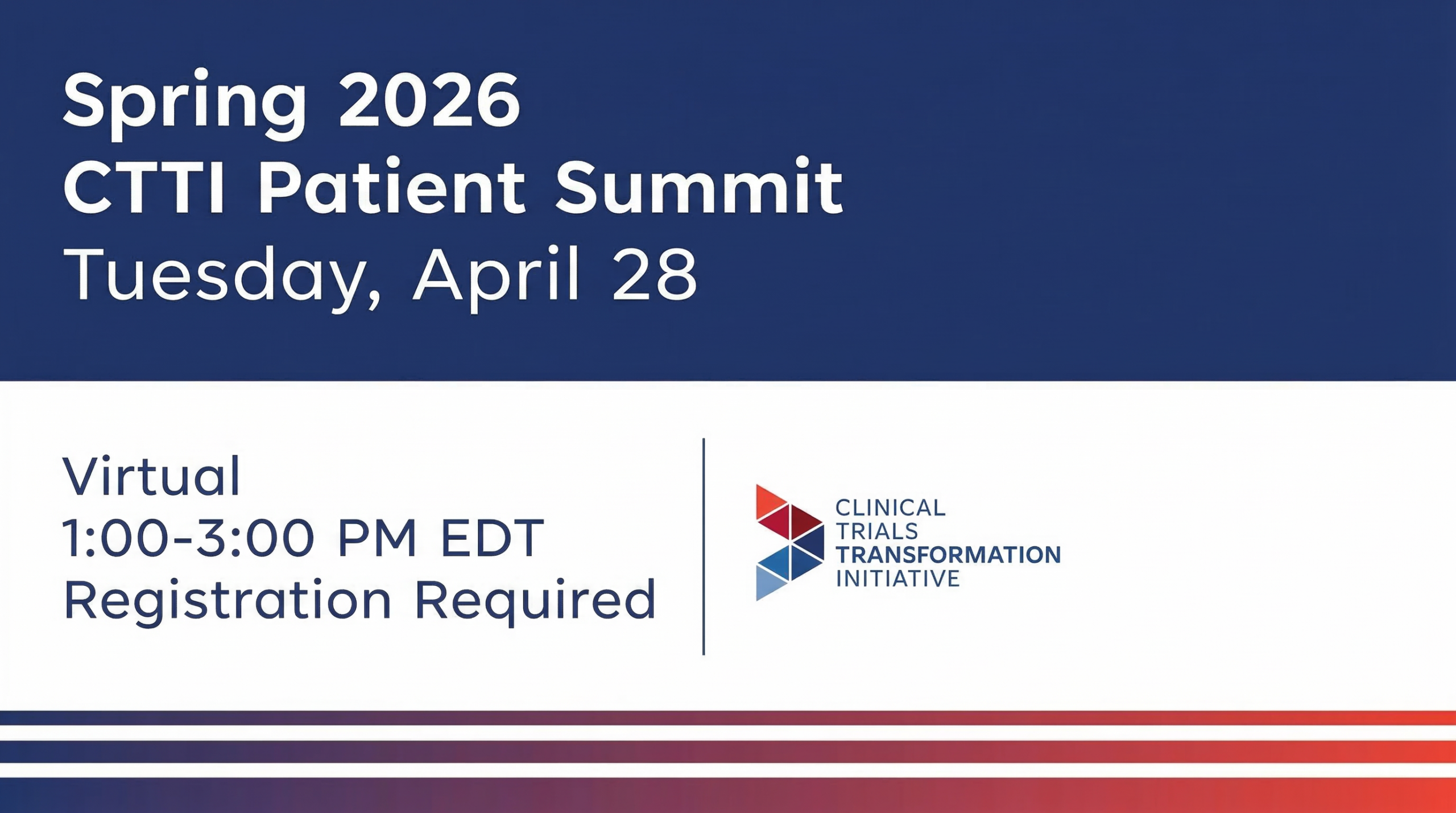
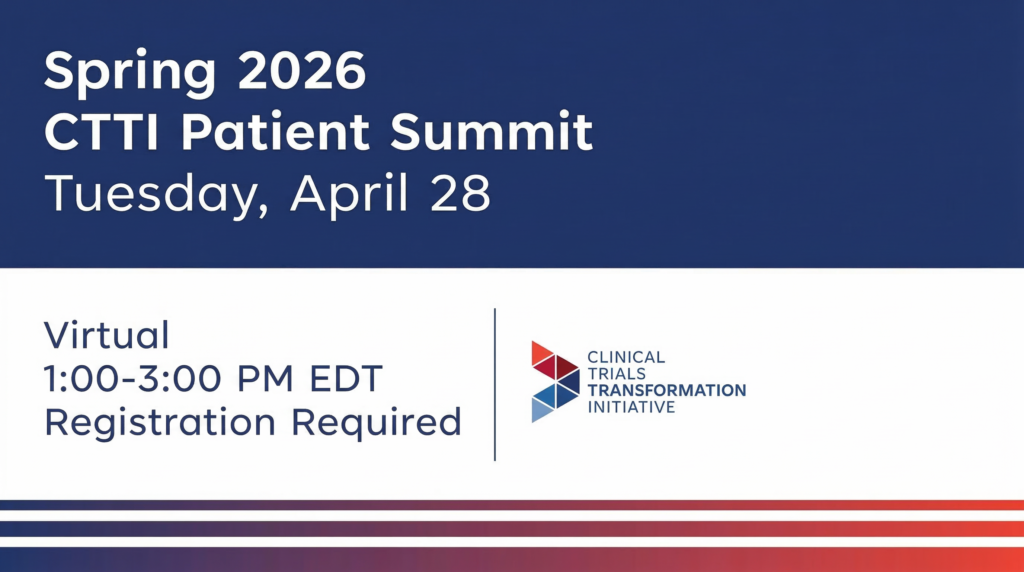
The CTTI Patient Summit on April 28, 2026, brings together patients, caregivers, and patient advocates to continue these discussions. Register now to attend.

Antibacterial Drug Development

Topics Included: Data Collecting and Reporting, Ensuring Quality, Innovative Trials, Patient Engagement, Regulatory Submissions + Approvals, Safety

Overview

Increasing bacterial resistance coupled with decreasing research on new antibacterial drugs is creating a crisis that could disproportionately impact our most vulnerable populations, including children and the seriously ill.  

CTTI has created approaches for streamlining antibacterial drug development that will help you design clinical trials that better assess the efficacy and safety of new antibacterial drugs and inform clinical trial planning, recruitment, enrollment, and feasibility. Use CTTI’s recommendations and resources to help combat this complex public health concern.

Projects

ABDD HABP/VABP STUDIES

Learn about CTTI’s prospective, multi-center, observational study of the risk factors for HABP/VABP.

ABDD PEDS TRIALS

Design pediatric antibacterial trials that ensure adequate enrollment, decrease the burden on sites and families, and increase engagement with healthcare providers.

ABDD STREAMLINING HABP/VABP TRIALS

Streamline protocol elements and data collection in HABP/VABP trials to increase enrollment, reduce trial complexity, and optimize operational efficiency.

ABDD UNMET NEED

Read about CTTI’s research findings on patient and physician perspectives and considerations as it relates to using antibacterial drugs developed through streamlined development processes.

Resources

Patient Engagement | CTTI News

Designing Trials for the Data We’ll Need Next: Dana Lewis on Participant Burden, Researcher Burden, and Consent in the AI Era

In advance of CTTI’s Patient Summit, Dana Lewis spoke with Morgan Hanger about data capture, consent, researcher assumptions, and why many trials remain anchored in outdated models.

Patient Engagement | Resources

PEC Meeting Summary – April 2025

PEC Meeting Summary – April 2025

Safety

Antibacterial Drug Development

Increasing bacterial resistance coupled with decreasing research on new antibacterial drugs is creating a crisis that could disproportionately impact our most vulnerable populations, including children and the seriously ill. CTTI...

Site Planning

Collective Strategies to Enhance Proportionate Enrollment

The Collective Strategies to Enhance Proportionate Enrollment project focuses on improving accountability, clarity, and communication across clinical trials partner groups to support more effective recruitment, enrollment, and retention practices. This...

Patient Engagement | CTTI News

Patient Engagement Collaborative Announces Eight New Members

Today, the U.S. Food and Drug Administration (FDA) and the Clinical Trials Transformation Initiative (CTTI) announced eight newly selected representatives for the Patient Engagement Collaborative (PEC).

Patient Engagement | Press Releases

CTTI and FDA Convene Workshop on Including Patient Perspectives in Clinical Trials

The Clinical Trials Transformation Initiative (CTTI) will convene a public workshop, “Enhancing the Incorporation of Patient Perspectives in Clinical Trials," in collaboration with the U.S. Food and Drug Administration (FDA)...

Site Planning | Press Releases

CTTI Launches New Online Digital Health Trials Hub

Today the Clinical Trials Transformation Initiative (CTTI) announced a new online Digital Health Trials Hub featuring enhanced recommendations and additional resources.

Site Planning | Press Releases

CTTI Offers Path Forward for Using Decentralized Clinical Trials

The Clinical Trials Transformation Initiative (CTTI) will unveil new recommendations to speed the use of decentralized clinical trials (DCTs)—trials run through telemedicine and mobile health care providers—today at the DPharm:...

Patient Engagement | Press Releases

CTTI and the FDA Select Representatives for Patient Engagement Collaborative

CTTI Project: Patient Engagement Collaborative The Clinical Trials Transformation Initiative (CTTI) and the U.S. Food and Drug Administration (FDA) announced newly selected representatives for the Patient Engagement Collaborative (PEC) today....

Patient Engagement | Press Releases

CTTI Selected to Support FDA Efforts to Increase Patient Engagement Through New Collaborative

CTTI has been engaged by the U.S. Food and Drug Administration (FDA) to support its Patient Engagement Collaborative (PEC), an effort created in partnership with CTTI to bring together members...

Formats

Stage of Trial

Collective Strategies to Enhance Proportionate Enrollment

Topics Included: Access to Clinical Trials, Patient Engagement, Recruitment, Regulatory Submissions + Approvals, Site Planning

The Collective Strategies to Enhance Proportionate Enrollment project focuses on improving accountability, clarity, and communication across clinical trials partner groups to support more effective recruitment, enrollment, and retention practices. This effort seeks to understand and address the challenges, expectations, and needs of each group involved in clinical trials, including contract research organizations, patient organizations, sites, and sponsors.

By fostering action-focused and unified engagement throughout the clinical trials process, the project aims to identify practical solutions that help plan, design, and execute trials better positioned to recruit and retain participants who reflect the epidemiology and scientific evidence of the disease under study. These efforts will support the generation of reliable, relevant, and robust data to inform the development of safe and effective medical products for all populations.

Key Takeaways

Resources

Patient Engagement | CTTI News

Designing Trials for the Data We’ll Need Next: Dana Lewis on Participant Burden, Researcher Burden, and Consent in the AI Era

In advance of CTTI’s Patient Summit, Dana Lewis spoke with Morgan Hanger about data capture, consent, researcher assumptions, and why many trials remain anchored in outdated models.

Patient Engagement | Resources

PEC Meeting Summary – April 2025

PEC Meeting Summary – April 2025

Safety

Antibacterial Drug Development

Increasing bacterial resistance coupled with decreasing research on new antibacterial drugs is creating a crisis that could disproportionately impact our most vulnerable populations, including children and the seriously ill. CTTI...

Patient Engagement | CTTI News

Patient Engagement Collaborative Announces Eight New Members

Today, the U.S. Food and Drug Administration (FDA) and the Clinical Trials Transformation Initiative (CTTI) announced eight newly selected representatives for the Patient Engagement Collaborative (PEC).

Patient Engagement | Press Releases

CTTI and FDA Convene Workshop on Including Patient Perspectives in Clinical Trials

The Clinical Trials Transformation Initiative (CTTI) will convene a public workshop, “Enhancing the Incorporation of Patient Perspectives in Clinical Trials," in collaboration with the U.S. Food and Drug Administration (FDA)...

Site Planning | Press Releases

CTTI Launches New Online Digital Health Trials Hub

Today the Clinical Trials Transformation Initiative (CTTI) announced a new online Digital Health Trials Hub featuring enhanced recommendations and additional resources.

Site Planning | Press Releases

CTTI Offers Path Forward for Using Decentralized Clinical Trials

The Clinical Trials Transformation Initiative (CTTI) will unveil new recommendations to speed the use of decentralized clinical trials (DCTs)—trials run through telemedicine and mobile health care providers—today at the DPharm:...

Patient Engagement | Press Releases

CTTI and the FDA Select Representatives for Patient Engagement Collaborative

CTTI Project: Patient Engagement Collaborative The Clinical Trials Transformation Initiative (CTTI) and the U.S. Food and Drug Administration (FDA) announced newly selected representatives for the Patient Engagement Collaborative (PEC) today....

Patient Engagement | Press Releases

CTTI Selected to Support FDA Efforts to Increase Patient Engagement Through New Collaborative

CTTI has been engaged by the U.S. Food and Drug Administration (FDA) to support its Patient Engagement Collaborative (PEC), an effort created in partnership with CTTI to bring together members...

Formats

Stage of Trial

Patient Engagement Collaborative Announces Eight New Members

CTTI News | December 11, 2024

Topics Included: Patient Engagement

Today, the U.S. Food and Drug Administration (FDA) and the Clinical Trials Transformation Initiative (CTTI) announced eight newly selected representatives for the Patient Engagement Collaborative (PEC). The group of 16 caregivers, patients, and patient group representatives meets with the FDA several times a year and discusses a variety of topics such as improving communications, education, and patient engagement related to medical product regulation. Those selected to the PEC are expected to serve for two years.

The eight new representatives are:

  • Bernard Coley
  • Lisa Craine
  • Rebecca Esparza
  • Syreen Goulmamine
  • Heather Guidone
  • Carter Hemion
  • Toni Jaudon
  • Mary Anne Meskis

The representatives were selected from 75 applications received in response to a Federal Register notice published in July 2024. These new members of the PEC include caregivers who have personal experience supporting someone with a health condition, patients who have personal disease experience, and representatives from patient groups who have direct or indirect disease experience. The selection committee, which included FDA staff from multiple centers, CTTI staff and several outgoing PEC members, worked to identify individuals with diverse perspectives and experiences who could meaningfully contribute and express the patient voice.

The PEC, a collaboration established by the FDA and CTTI in 2018, is a group of patient organizations and individual representatives who discuss ways to enhance patient engagement. The FDA and CTTI collaborate to involve representatives with a variety of perspectives including caregivers, patients, and representatives from diverse patient organizations and communities. The PEC is run by the FDA’s Public Engagement Staff, which is responsible for communicating, educating, and engaging with external partners including academia, caregivers, consumers, health care providers, patients, and trade associations on the agency’s policy priorities.

Going forward, the PEC will continue the dialogue around how patient perspectives can inform the clinical trials enterprise and provide information and resources to enhance PEC members’ knowledge about the FDA and CTTI activities to share with patient communities. Previous topics have included: increasing awareness of existing engagement mechanisms among patients and patient groups; increasing patients’ education to empower them to act as representatives of their broader community; enhancing communication between the FDA and patient communities; and promoting global collaboration of patient organizations.

The FDA and CTTI wish to thank the outgoing members for their service to the PEC over the past several years:

  • Kim Hindery
  • Yasmin Ibrahim
  • Seth Morgan
  • Cara O’Neill
  • Ceciel Rooker
  • Christina Sisti
  • Trina Stelly
  • Lauren Youngborg

Since 2008, CTTI has included patient advocates on its Executive Committee, Steering Committee, and project teams and, today, nearly all of its more than 30 sets of evidence-based recommendations and associated frameworks and tools mention inclusion of patients as a critical part of the clinical trials process.

CTTI and FDA Convene Workshop on Including Patient Perspectives in Clinical Trials

[yoast-breadcrumb]

CTTI Project: Patient Group Engagement

The Clinical Trials Transformation Initiative (CTTI) will convene a public workshop, “Enhancing the Incorporation of Patient Perspectives in Clinical Trials," in collaboration with the U.S. Food and Drug Administration (FDA) on Mon., March 18, from 9:00 a.m. to 5:00 p.m. at the Tommy Douglas Conference Center in Silver Spring, Md.

PDF icon Download Press Release (262.53 KB)

CTTI and the FDA Select Representatives for Patient Engagement Collaborative

CTTI Project: Patient Engagement Collaborative

The Clinical Trials Transformation Initiative (CTTI) and the U.S. Food and Drug Administration (FDA) announced newly selected representatives for the Patient Engagement Collaborative (PEC) today. The group of 16 patients, caregivers, and patient group representatives will meet with the FDA several times a year to discuss topics such as communication, transparency, and the best ways for patients to participate in the FDA’s regulatory discussions about medical products.

PDF icon Download Press Release (280.48 KB)

CTTI Selected to Support FDA Efforts to Increase Patient Engagement Through New Collaborative

[yoast-breadcrumb]

CTTI Project: Patient Engagement Collaborative

CTTI has been engaged by the U.S. Food and Drug Administration (FDA) to support its Patient Engagement Collaborative (PEC), an effort created in partnership with CTTI to bring together members of the patient community to discuss the best ways for patients to participate in the FDA’s regulatory discussions about medical products.

PDF icon Download Press Release (262.58 KB)