


Quality by Design Helps EMD Serono Streamline its Protocol Through Inclusion of New Perspectives
Quality
CTTI Holds Meeting to Discuss the Systemic Changes Needed to Increase Diversity in Clinical Trials
The Clinical Trials Transformation Initiative (CTTI) held a two-day multi-stakeholder expert meeting on Oct. 12 & 21 to discuss the systemic changes needed to ensure that U.S. clinical trials better meet the needs of diverse populations, including racial minorities, ethnic minorities, and women. At the meeting, leaders and key stakeholders from across the clinical trials ecosystem participated in an engaging forum, informative discussions, and lively breakout sessions that shed more light on new solutions for sharing information and ensuring sufficient resource allocation to diversity, equity, and inclusion initiatives.
Meeting attendees also identified some important themes and identified opportunities to increase diversity in clinical trials:
- The benefits are indisputable. Including a diverse population in clinical trials improves the quality of science, enhances patient trust, increases patient recruitment and retention, and improves clinical care for all patients.
- A culture shift is needed. Organizations need to ingrain diversity, equity, and inclusion initiatives into their portfolio-level strategy and within their overall mission. They should foster bi-directional community partnerships and directly engage patients in the design and planning of clinical trials and diversity efforts from the very beginning.
- This is a full group effort. Increasing diversity in clinical trials is a multi-stakeholder effort that will take all groups working together to achieve goals of clinical trial populations representing the populations who are affected by disease.
- There is important work ahead of us. Meeting attendees provided feedback on CTTI’s draft maturity model, helping to create a better public resource. Suggested additions included a focus on values and guidelines that are generalizable to a wide variety of stakeholders, not just industry stakeholders, and more guidance on how organizations can measure their progress through the maturity model.
CTTI is now using these findings – along with other research results and multi-stakeholder discussions – to develop recommendations and resources for release in early 2022. The project team may host additional webinars focusing on case studies and implementation of resources.
Report Now Available: ICH E6 Guideline for Good Clinical Practice (GCP) – Update on Progress
The report of the public web conference on “ICH E6 Guideline for Good Clinical Practice (GCP) – Update on Progress,” organized by International Council for Harmonisation (ICH) and convened by the Clinical Trials Transformation Initiative (CTTI), is now available. The web conference, which consisted of identical meetings at different times on May 18 & 19 to accommodate a global audience, reached more than 5100 attendees.
The ICH E6 Expert Working Group (EWG) members, who are updating the guideline, presented a video wherein they shared the ICH guideline development process and the approach to updating ICH E6 The video was followed by presentations on the vision and goals for updating the ICH E6 guideline and on lessons learned from public input and stakeholder feedback on the ICH E6 revision process. In the final session, EWG members discussed the draft principles, which were published in April. Key stakeholders closed the web conference by sharing their visions and aspirations for clinical trials.
Check out the recording and the slide decks for each day of the web conference to learn more from the presenters.
For additional information on updating the ICH E6, please refer to the following materials:
- ICH E6 main page (ich.org)
- ICH E6(R3) Concept Paper
- Summary of the ICH E6 engagement proposal
- ICH E6 Good Clinical Practice (GCP) Draft Principles
- CTTI’s Informing the Update of ICH E6 Work
- 2020 CTTI Research & Findings

Get Started
QbD Toolkit: Overview, Learn About QbD , Teach Others About QbD, QbD Principles Document, Exploring the CTQ Factors, Workshop Tools, Adopt QbD, How Others are Using QbD, Get Started
QbD Toolkit Resources: Principles Document, CTTI QbD Recommendations, Key Stakeholders, Maturity Model, Metrics Framework, Case Studies
SHARE TO:


Getting started with QbD can feel overwhelming, but utilizing our QbD Toolkit will help you. Watch as Coleen Glessner from Pfizer shares her tips on how to get started with QbD within your organization.
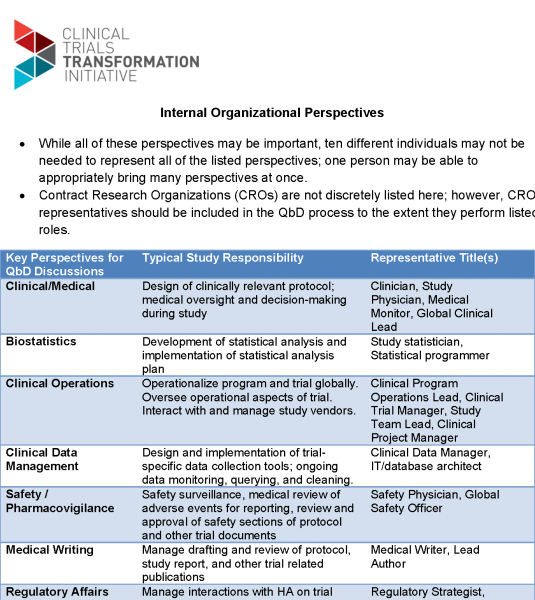
Perspectives & Champions
CTTI shares considerations for internal and external perspectives as well as internal champions.
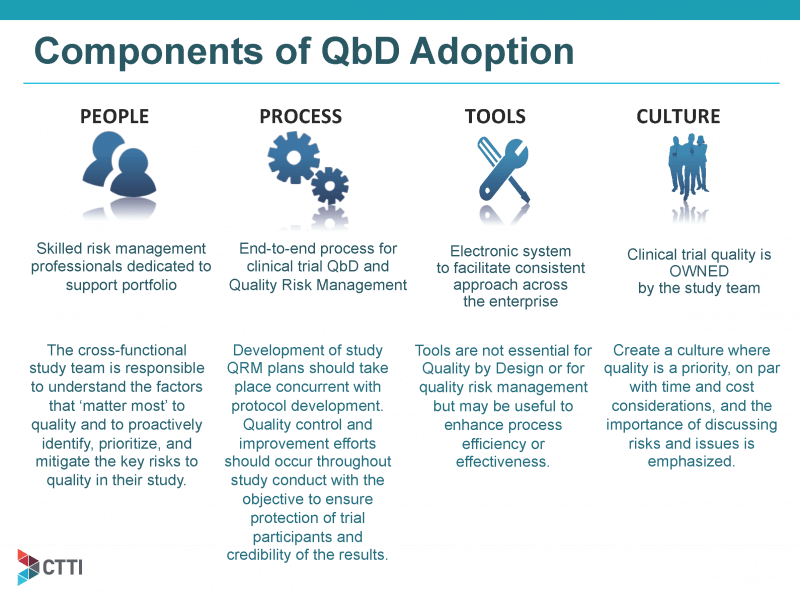
Components for QbD Adoption
This resource describes the four key components needed for a successful QbD implementation.
Exploring the Critical to Quality (CTQ) Factors
QbD Toolkit: Overview, Learn About QbD , Teach Others About QbD, QbD Principles Document, Exploring the CTQ Factors, Workshop Tools, Adopt QbD, How Others are Using QbD, Get Started
QbD Toolkit Resources: Principles Document, CTTI QbD Recommendations, Key Stakeholders, Maturity Model, Metrics Framework, Case Studies
SHARE TO:
 Using the Principles Document should be a thinking exercise, not a 'check the box' exercise. We encourage you to further explore the various Critical To Quality factors (CTQs) by selecting categories on the image to the left. Additional details are provided below to give the description / rationale for the various factors within each category, as well as potential considerations in evaluating the relative importance of the CTQ factor for your study.
Protocol Design
Feasibility
Patient Safety
Study Conduct
Study Reporting
Third-Party Engagement
QbD Principles Document
QbD Toolkit: Overview, Learn About QbD , Teach Others About QbD, QbD Principles Document, Exploring the CTQ Factors, Workshop Tools, Adopt QbD, How Others are Using QbD, Get Started
QbD Toolkit Resources: Principles Document, CTTI QbD Recommendations, Key Stakeholders, Maturity Model, Metrics Framework, Case Studies
SHARE TO:
The Principles Document outlines high-level principles for building quality into trials and is intended as a tool for inquiry into “critical to quality” factors (CTQs) and associated risks. The Principles Document asks questions to promote proactive, cross-functional discussions and critical thinking at the time of trial development about what is critical to quality for a specific trial, and about the events that might impede or facilitate achieving quality. It is not intended to be all-inclusive, serve as a checklist to be completed in isolation, or be a substitute for experience and critical thinking. Watch Ann Meeker-O'Connell from Johnson & Johnson provide an introduction to the QbD Principles Document.

PRINCIPLES DOCUMENT
The Principles Document (full text) is a reference tool for inquiry into “critical to quality” factors (CTQs). Note that this is NOT intended to be used as a checklist.
EXPLORING THE
CTQS
CTQs can be grouped into categories of feasibility, protocol design, patient safety, study conduct, study reporting and third-party service providers. We encourage you to use our Interactive tool to explore CTQs from the Principles Document.
PRESENTATION ON THE PRINCIPLES DOCUMENT
Presentation that reviews the Principles Document and how it can be used to facilitate ad
Workshop Tools
QbD Toolkit: Overview, Learn About QbD , Teach Others About QbD, QbD Principles Document, Exploring the CTQ Factors, Workshop Tools, Adopt QbD, How Others are Using QbD, Get Started
QbD Toolkit Resources: Principles Document, CTTI QbD Recommendations, Key Stakeholders, Maturity Model, Metrics Framework, Case Studies
SHARE TO:
 Tools for hosting a QbD workshop within your own organization are provided. This includes case studies and a facilitation guide to educate attendees about clinical QbD and how to apply the QbD principles through hands-on exercises during breakout sessions. In addition, PowerPoint slide decks are provided as templates to build your own workshop. Past CTTI QbD workshop materials also are good resources.

MODEL AGENDA FOR A QBD WORKSHOP
Slides with a model agenda are provided for customizing your own QbD workshop.

CTTI'S QBD WORKSHOP TEMPLATE DECK
QbD workshop slide templates are provided that introduce QbD concepts and thinking exercises to use the Principles Document.

QBD WORKSHOP FACILITATOR TIPS
Tips and recommendations are provided to support the QbD workshop facilitator.
CASE STUDIES
Four case studies are provided to use in your Qbd Workshop. In CTTI-convened workshops, we have found it highly valuable to use case study exercises to help attendees understand how to use the Principles Document and to demonstrate the QbD approach.