


Quality
New CTTI Project to Develop Common Framework to Assess Progress Towards TT2030 Vision
 Clinical trials are critical components of the evidence generating system in research. Launched in 2021, CTTI’s Transforming Trials 2030 vision outlines five pillars for how clinical trials should be performed by 2030. This vision establishes that clinical trials need to be patient centered and easily accessible, fully integrated into health processes, designed with a quality approach, maximally leveraging all available data, and improving population health. Currently, the TT2030 vision lacks metrics to demonstrate progress towards the vision’s five central goals. The Measuring Trials Transformation (MTT) Project will develop a common framework to evaluate and assess the progress made towards achieving the five main goals of the TT2030 vision, a framework that can be used to share accountability across the clinical trials enterprise.
After launching the TT2030 vision, CTTI conducted concept elicitation interviews to develop key concepts metrics should address within each pillar. In 2022 and early 2023, CTTI conducted surveys of experts to assess the value of individual metrics for assessing progress towards the vision.
To deploy a set of relevant metrics, CTTI will utilize a variety of iterative strategies, including interviews with key stakeholders on their experiences with each pillar and ideas for related metrics, expert surveys on draft measures for each pillar, and an online public forum on the measurement framework. The selected metrics will be further refined by integrating public comment, expert input, and project team feedback and discussions. CTTI will perform a case study using the framework of metrics to measure progress towards the TT2030 vision by collecting and reporting an initial set of metrics using recent clinical trials.
CTTI understands that some goals of the TT2030 vision will be achieved sooner than others, and so the framework created by the MTT Project will establish key milestones to assess progress made by the program over time. CTTI will use this vision to guide their priorities, and they will encourage others to do the same, facilitating accountability across the entire clinical trials industry.
The Metrics Framework is currently open for public comment until mid-October 2023. Please view the dashboard and provide your suggestions and feedback here.
FDA, CTTI Convening Virtual Public Workshop on Enhancing Clinical Study Diversity
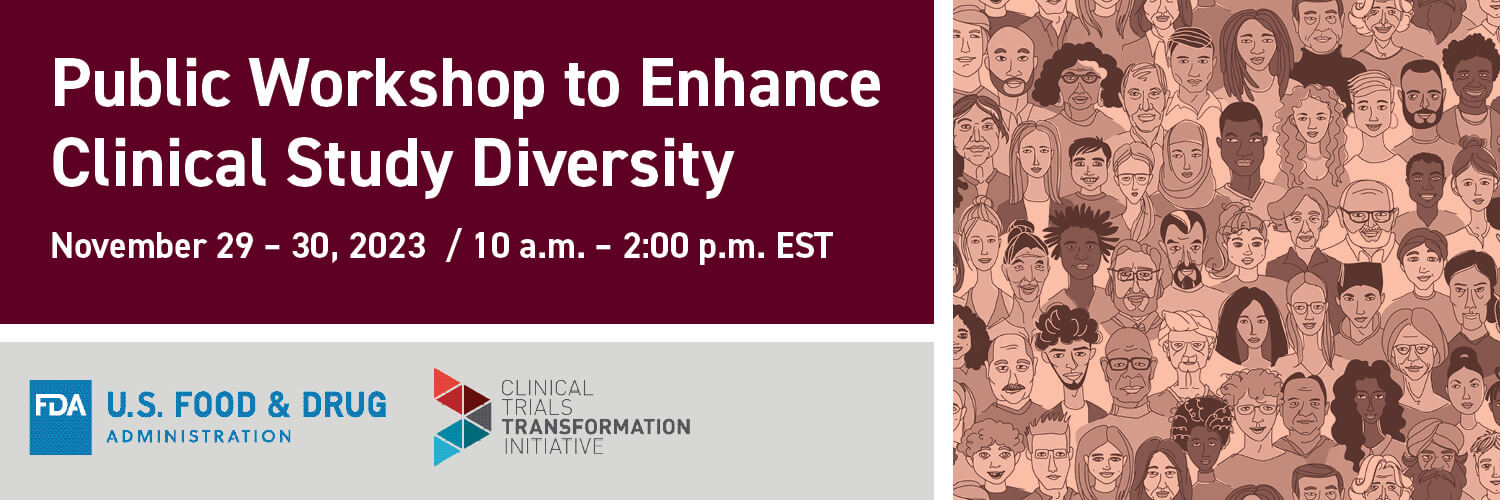
The U.S. Food and Drug Administration (FDA), in collaboration with the Clinical Trials Transformation Initiative (CTTI), is convening a virtual public workshop to solicit input on increasing the enrollment of historically underrepresented populations in clinical studies and encouraging clinical study participation that reflects the prevalence of the disease or condition among demographic subgroups.
The free two-day virtual public workshop will be held on November 29 and 30, 2023, from 10 a.m. – 2 p.m. EST on both days. Registration for the workshop is now open and an agenda for the workshop can be viewed here.
We are inviting those who register to submit questions for our speakers and panelists in advance of the meeting. Please click here to submit your questions.
Representatives from academia, clinical research organizations, drug sponsors, medical device sponsors, patients, and other interested parties will share their experiences and approaches for increasing enrollment and encouraging participation of historically underrepresented populations in clinical studies.
The workshop fulfills a requirement under section 3603 of the Food and Drug Omnibus Reform Act of 2022 (FDORA).
Recording Now Available: CTTI Webinar Unveiling New Recommendations on Increasing Diversity in Clinical Trials
A recording of CTTI’s May 18 webinar unveiling the new recommendations on increasing diversity in clinical trials is now available.
The one-hour webinar includes a welcome from Sally Okun, CTTI; opening remarks from Richardae Araojo, U.S. Food and Drug Administration (FDA); a project overview from Luther Clark, Merck; a maturity model overview from Dawn Corbett, NIH; and a panel discussion moderated by Sara Calvert, CTTI. The panel discussion focused on stakeholder perspectives related to the integration of the of the new diversity recommendations and included Ruma Bhagat, Genentech-a member of the Roche Group; Tesheia Johnson, Yale; Jane Williams, Syneos Health; and Glendon Zinser, Susan G. Komen.
The goal of creating these diversity recommendations is to increase the inclusion and adequate representation of women and historically underrepresented racial and ethnic groups in clinical trials to facilitate more accurate and generalizable trial results by enhancing and expanding our understanding of the safety and efficacy of investigational medical products. These recommendations were developed in collaboration with experts and key stakeholders from across the clinical trials enterprise using CTTI’s five-step methodology designed to ensure they are actionable, evidence-based, and consensus-driven. The first phase involved gathering input through qualitative, in-depth interviews with senior-level leaders at organizations conducting clinical trials to gather perspectives on strategies to support diversity and inclusion in clinical research. The recommendations were drafted and refined with input from a multi-stakeholder project team and through a 2-day Expert Meeting.
View the slide deck to read more.
CTTI to Launch New Diversity Recommendations at Free Public Webinar
CTTI will host a free public webinar on Thursday, May 18 at 12:00 p.m. EDT to unveil new recommendations for increasing diversity in clinical trials.
The webinar will include a welcome from Sally Okun, CTTI; opening remarks from Richardae Araojo, U.S. Food and Drug Administration (FDA); a project overview from Luther Clark, Merck; a maturity model overview from Dawn Corbett, NIH; and a panel discussion that will focus on stakeholder perspectives related to the integration of the new recommendations.
The inclusion and adequate representation of women and historically underrepresented racial and ethnic groups in clinical trials leads to more accurate and generalizable trial results by enhancing and expanding our understanding of the safety and efficacy of investigational medical products. In addition, inclusion of all the populations who are affected by a condition can improve access to innovative and potentially life-extending and life-improving therapies, develop trust in clinical trial results, and facilitate uptake if the medical product is approved.
As part of the Diversity Project, experts and key stakeholders from across the clinical trials enterprise developed the recommendations following CTTI’s five-step methodology designed to ensure they are actionable, evidence-based, and consensus-driven. The CTTI recommendations and supporting maturity model seek to build on the growing recognized need for long-term, transformative strategies that are rooted in a deep organizational commitment to developing clinical trial research infrastructure that is more responsive to the needs of historically underrepresented populations.
Register for the free one-hour webinar.
CTTI Holds Meeting to Discuss Engaging Stakeholders in Trial Design
The Clinical Trials Transformation Initiative (CTTI) held a multi-stakeholder Expert Meeting on April 4 to discuss high-value approaches and situation-specific considerations for meaningful engagement of internal and external stakeholders in clinical trial design and implementation. Engaging all stakeholders during the earliest stages of study development is an important feature of quality by design (QbD). Aligned with CTTI’s QbD approach, the Engaging Stakeholders in Trial Design Project team is developing an engagement roadmap and recommendations to enable clinical trial designers to meaningfully and effectively engage all stakeholders across the trial design process. The project team is also collating resources surrounding the engagement of stakeholders to increase the efficiency of trial design to benefit patients faster.
Experts from academia, clinical research organizations, patient advocacy groups, regulatory agencies, and the pharmaceutical industry discussed the challenges and opportunities, key strategies, and metrics for assessing holistic stakeholder engagement across the continuum of clinical trials. The following key themes were emphasized during the meeting:
- It is important to engage key stakeholders – including patients, site staff, and regulatory agencies – very early in the design of clinical trials. When planning study timelines, identify all internal and external stakeholders and the appropriate time and approach to solicit their input.
- Stakeholder engagement should be an iterative process throughout the life cycle of clinical trials. Internal and external stakeholders should be engaged, as appropriate, from the beginning of clinical trial design through the dissemination of results.
- Bring stakeholders and functional groups together to identify gaps between teams and brainstorm solutions to increase the quality and efficiency of trials. Effective communication and collaboration across all stakeholder groups is crucial to create a community around designing high-quality studies that meet the needs of patients and that generate reliable evidence with fewer amendments.
- Advanced methodologies and tools, such as artificial intelligence and machine learning, can help study designers develop innovative, high-quality trials and streamline processes. With databases of real-world and clinical trial data, artificial intelligence and machine learning can be used to inform the design of trials, explore potential treatments for patient subgroups, assess feasibility of enrollment, and identify sites.
- A collection of resources for designing clinical trials, including recommendations on how and when to meaningfully engage all stakeholders, is needed to help study designers plan innovative clinical trials more efficiently and in alignment with regulatory guidance.
Engaging Stakeholders in Trial Design Expert Meeting
April 4, 2023
CTTI Project: Engaging All Stakeholders in Clinical Trial Design
Meeting Objectives:
- Review two clinical trial ‘models’ where stakeholder engagement was well-executed
- Discuss and explore opportunities, barriers, and best practices for study designers to engage all stakeholders in trial design
- Identify situation-specific considerations for ensuring engagement is appropriately equitable, effective, and feasible
Meeting Location: Washington, D.C.
Meeting Materials:
- Welcome Remarks and Opening Comments
- Introduction to the Clinical Trials Transformation Initiative (CTTI)
- Engaging Stakeholders in Trial Design Project Overview
- Meeting Objectives
- Session 1: Models for Success
- Review of two well-executed trials
- Key milestones and interactions that supported success
- Discussion: What does a well-engaged trial look like?
- Methods and milestones
- Roadblocks to engagement
- Session 2: Challenges and Opportunities
- Panel discussion: opportunities, barriers, and best practices for engaging all stakeholders in trial design
- Building the value proposition of engaging stakeholders in trial design
- Timing of stakeholder engagement
- Operationalizing stakeholder feedback
- Simplifying the process
- Measuring the impact
- Panel discussion: opportunities, barriers, and best practices for engaging all stakeholders in trial design
- Session 3: Break Out Sessions
- Timing of stakeholder engagement
- Simplifying the stakeholder engagement process
- Measuring the impact of stakeholder engagement in the design of clinical trials
The views and opinions expressed in these presentations are those of the individual presenter and should not be attributed to the Clinical Trials Transformation Initiative, or any organization with which the presenter is employed or affiliated.