


Author: Hannah Faulkner
Recording of Virtual Public Meeting Now Available: Mitigating Clinical Study Disruptions During Disasters and Public Health Emergencies (PHEs)
A recording of the virtual public meeting “Mitigating Clinical Study Disruptions During Disasters and Public Health Emergencies (PHEs),” convened by the U.S. Food and Drug Administration (FDA) and Clinical Trials Transformation Initiative (CTTI) held October 18th and 19th, is now available.
Day 1 of the virtual public meeting opened with welcoming remarks from Janet Woodcock, FDA’s Principal Deputy Commissioner. Following the opening remarks, Jacqueline Corrigan-Curay of the FDA’s Center for Drug Evaluation and Research (CDER) provided an overview of the FDA’s activities and responses to address the COVID-19 public health emergency and clinical trial conduct disruptions. Following the presentations, three panel sessions were held and panelists discussed various topics related to clinical trial disruptions during COVID-19. The first day concluded with closing remarks from CTTI Executive Director Sally Okun.
Day 2 of the meeting began with opening remarks from Celia Witten of the FDA’s Center for Biologics Evaluation and Research (CBER). Following the opening remarks, panel discussions were held on federal partners’ experience related to trial disruptions and strategies for emergency preparedness in clinical studies. The second and final day of the meeting concluded with closing remarks from M. Khair ElZarrad of the Office of Medical Policy at CDER.
View the full slide deck to learn more about methods to mitigate clinical study disruptions during disasters and public health emergencies.
For additional information on the FDA guidance on conduct of clinical trials of medical products during the COVID-19 public health emergency, please see the updated final guidance document. This meeting fulfilled a requirement under section 3605 of the Food and Drug Omnibus Reform Act of 2022 (FDORA).
Please join us on November 29 and 30, 2023, for another FDORA virtual public workshop on enhancing clinical study diversity. Registration information and a full workshop agenda can be found here.
CTTI Announces Promotion of Morgan Hanger to Executive Director
 Today, CTTI proudly announced Morgan Hanger as its next Executive Director.
“CTTI has been at the center of advancing clinical trial transformation through public-private collaboration, and that leadership will continue under Morgan Hanger,” said Dr. Mark McClellan, CTTI Executive Committee Chair, and Founding Director, Duke-Margolis Center for Health Policy. “Combined with Sally Okun’s lasting contributions, a thoughtful transition plan, and a strong team, CTTI is uniquely positioned—at critical time—to identify and support innovative strategies to speed the development of better clinical evidence to help more patients at a lower cost.”
Serving as CTTI’s Director of Strategic Programs since January 2022, Hanger has collaborated on strategic initiatives related to the organization’s Transforming Trials 2030 vision and led the early-stage activities of CTTI’s newest project, Measuring Trials Transformation. Prior to CTTI, she spent three years as an independent consultant advising health technology companies and innovators on the development of new products. Previously, she served as vice president of the online patient research network PatientsLikeMe (PLM), where she led programs utilizing patient-generated health data in life sciences and regulatory settings. Hanger’s earlier work provided consulting and advisory services to leading pharma, biotech companies, and professional societies to create more effective research strategies. She also held positions within the Health Outcomes Group at Memorial Sloan Kettering Cancer Center and the Congressional Budget Office.
“I am excited and honored to lead CTTI at such an exciting moment in its trajectory,” Hanger said. “We have terrific members, partners, and a highly adaptive and talented team, all of whom are eager to drive change across the clinical trials enterprise. We will continue to lean into the transformation part of our directive by deepening our implementation resources, focusing on enterprise-wide measurement, and supporting the FDA as they anticipate and facilitate the evolution of trials with modernized designs, data, and capabilities.”
“I know I speak for the entire CTTI team in celebrating Morgan’s promotion to the Executive Director position,” said Sally Okun, CTTI’s current Executive Director, who is retiring at the end of this year. “Over the past two years, Morgan’s unique combination of innovative thinking, operational skills, and inclusive engagement have guided the development of an impactful and measurable strategic plan. It is a rare privilege to have a person of Morgan’s caliber so well positioned to seamlessly continue advancing CTTI towards its transformational 2030 vision.”
Hanger, who assumes her new role in January 2024, will work closely over the next several months with Okun to ensure a smooth transition. Both Hanger and Okun are working with Executive Committee leadership – Chair Mark McClellan, Duke Co-chair John Alexander, and FDA Co-chair Khair ElZarrad – on a thoughtful succession plan that ensures the highest level of team and organizational integrity. In addition, the CTTI team is actively involved in this transition process – one that considers their voices and reflects their perspectives about the next generation of CTTI leadership and its strategy moving forward.
New CTTI Project to Develop Common Framework to Assess Progress Towards TT2030 Vision
 Clinical trials are critical components of the evidence generating system in research. Launched in 2021, CTTI’s Transforming Trials 2030 vision outlines five pillars for how clinical trials should be performed by 2030. This vision establishes that clinical trials need to be patient centered and easily accessible, fully integrated into health processes, designed with a quality approach, maximally leveraging all available data, and improving population health. Currently, the TT2030 vision lacks metrics to demonstrate progress towards the vision’s five central goals. The Measuring Trials Transformation (MTT) Project will develop a common framework to evaluate and assess the progress made towards achieving the five main goals of the TT2030 vision, a framework that can be used to share accountability across the clinical trials enterprise.
After launching the TT2030 vision, CTTI conducted concept elicitation interviews to develop key concepts metrics should address within each pillar. In 2022 and early 2023, CTTI conducted surveys of experts to assess the value of individual metrics for assessing progress towards the vision.
To deploy a set of relevant metrics, CTTI will utilize a variety of iterative strategies, including interviews with key stakeholders on their experiences with each pillar and ideas for related metrics, expert surveys on draft measures for each pillar, and an online public forum on the measurement framework. The selected metrics will be further refined by integrating public comment, expert input, and project team feedback and discussions. CTTI will perform a case study using the framework of metrics to measure progress towards the TT2030 vision by collecting and reporting an initial set of metrics using recent clinical trials.
CTTI understands that some goals of the TT2030 vision will be achieved sooner than others, and so the framework created by the MTT Project will establish key milestones to assess progress made by the program over time. CTTI will use this vision to guide their priorities, and they will encourage others to do the same, facilitating accountability across the entire clinical trials industry.
The Metrics Framework is currently open for public comment until mid-October 2023. Please view the dashboard and provide your suggestions and feedback here.
FDA, CTTI Convening Virtual Public Workshop on Enhancing Clinical Study Diversity
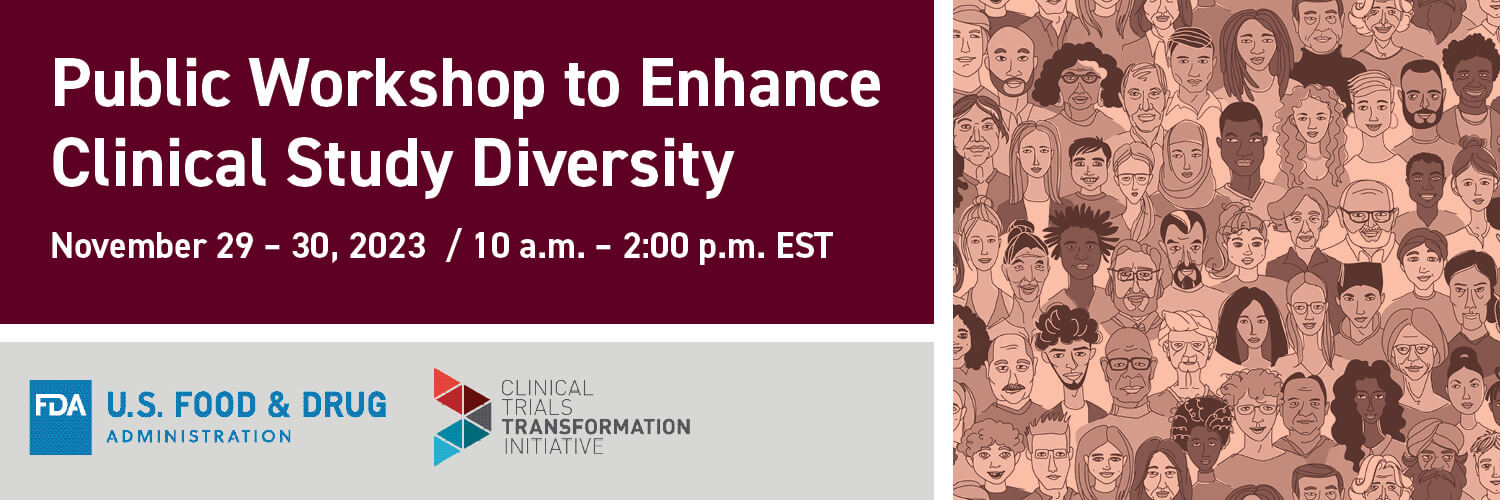
The U.S. Food and Drug Administration (FDA), in collaboration with the Clinical Trials Transformation Initiative (CTTI), is convening a virtual public workshop to solicit input on increasing the enrollment of historically underrepresented populations in clinical studies and encouraging clinical study participation that reflects the prevalence of the disease or condition among demographic subgroups.
The free two-day virtual public workshop will be held on November 29 and 30, 2023, from 10 a.m. – 2 p.m. EST on both days. Registration for the workshop is now open and an agenda for the workshop can be viewed here.
We are inviting those who register to submit questions for our speakers and panelists in advance of the meeting. Please click here to submit your questions.
Representatives from academia, clinical research organizations, drug sponsors, medical device sponsors, patients, and other interested parties will share their experiences and approaches for increasing enrollment and encouraging participation of historically underrepresented populations in clinical studies.
The workshop fulfills a requirement under section 3603 of the Food and Drug Omnibus Reform Act of 2022 (FDORA).
CTTI Executive Director Sally Okun Announces Retirement
 I wanted to let you know that after much consideration and reflection I am retiring from my position as Executive Director of the Clinical Trials Transformation Initiative by the end of 2023.
My time at CTTI has been incredibly rewarding both professionally and personally and my decision to retire was not an easy one. I am grateful for the support, opportunities, and camaraderie I have experienced throughout my time here. As I prepare to embark on a new chapter after five decades in healthcare, I feel a mixture of emotions, including excitement, as I contemplate the future for me and my loved ones.
When I arrived at CTTI in October of 2021, we were navigating our way into a post pandemic world and changing clinical trial ecosystem. Our CTTI team and members stepped up to meet these challenges and opportunities with creativity, curiosity, and resilience. It has been a privilege to work alongside this talented team and the many dedicated professionals, patients, and caregivers from across our membership who demonstrate their commitment to CTTI’s mission and bold vision each day.
Over the next several months, I am committed to ensuring a smooth transition of my responsibilities to my successor. I’m working closely with Duke and CTTI’s Executive Committee leadership – Chair Mark McClellan, Duke Co-chair John Alexander, and FDA Co-chair Khair ElZarrad – on a thoughtful and mindful succession plan that ensures the highest level of team and organizational integrity.
In addition, the CTTI team is actively involved in developing a transition process that includes their voices and reflects their perspectives about the next generation of leadership for our organization. The job posting for the Executive Director of CTTI has posted to Duke’s career webpage. I welcome any thoughts, ideas, and suggestions you wish to share as we begin this process.
And finally, I want to express my deepest gratitude to our CTTI community for making my experience with CTTI unforgettable. It gives me great pride to have been a part of CTTI’s work and achievements during my tenure. Our exciting and important work continues this fall and rest assured we won’t miss a beat with this transition.