Presentation: Establishing a Global Industry Reporting Standard for Clinical Research Data: Public health, ethics, and business considerations in response to Declaration of Helsinki revisions
Date: Tuesday, June 24, 9:45 – 10:30 a.m.
Presenter: Morgan Hanger (CTTI)
Formats
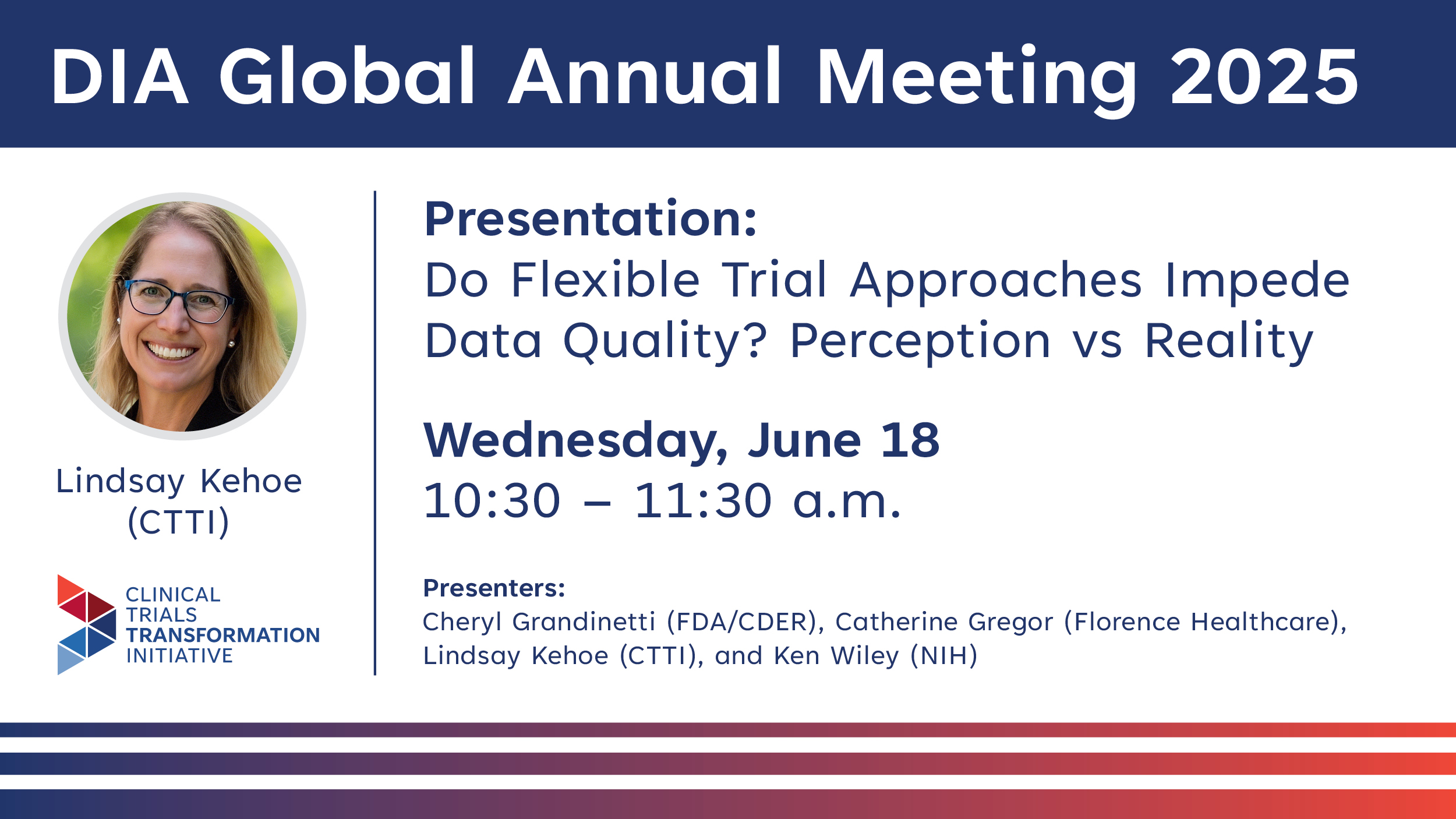
DIA Global Annual Meeting 2025
Presentation: Do Flexible Trial Approaches Impede Data Quality? Perception vs Reality
Date: Wednesday, June 18, 10:30 - 11:30 a.m.
Presenter: Cheryl Grandinetti (FDA/CDER), Catherine Gregor (Florence Healthcare), Lindsay Kehoe (CTTI), and Ken Wiley (NIH)
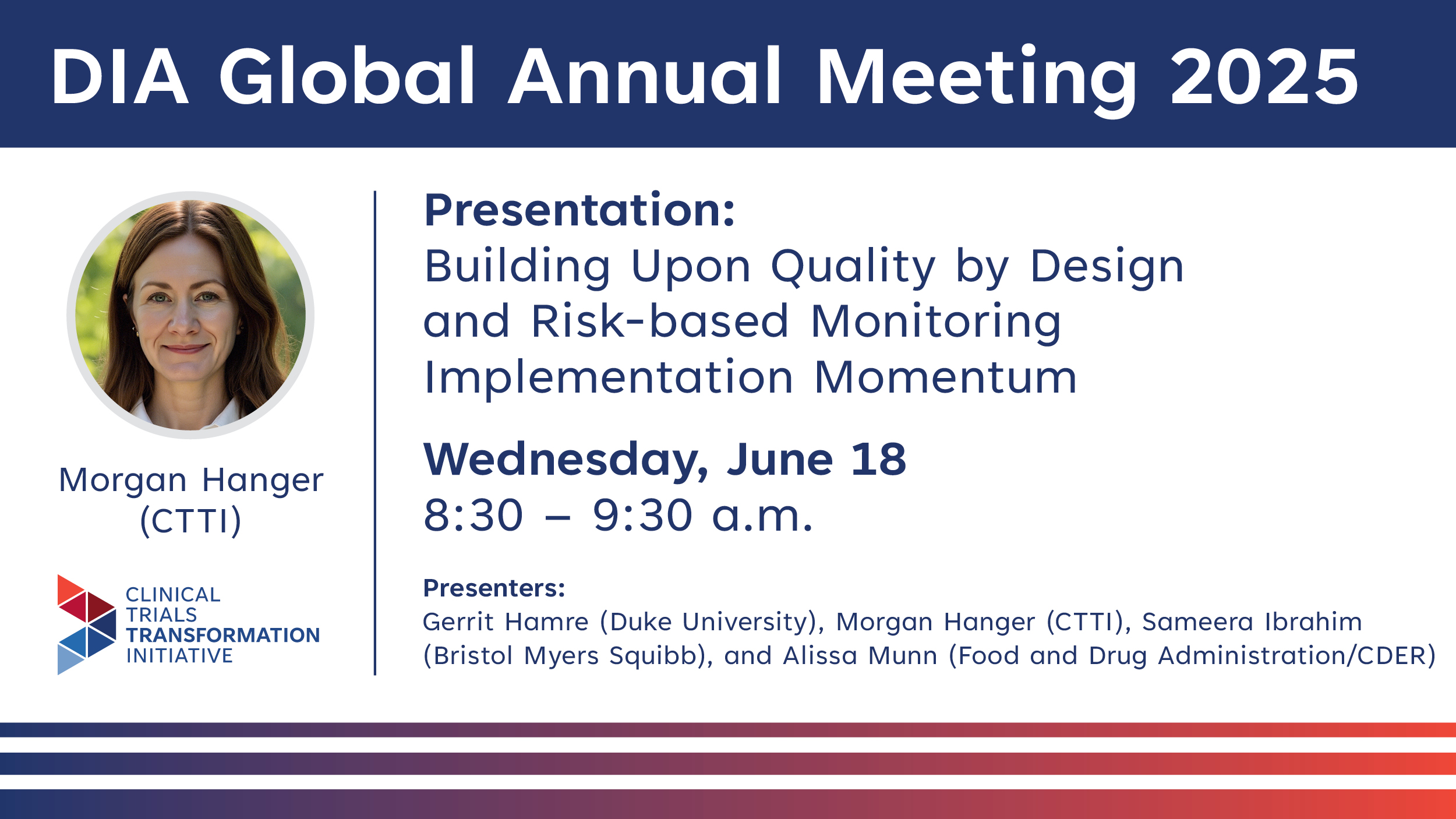
DIA Global Annual Meeting 2025
Presentation: Building Upon Quality by design and Risk-based Monitoring Implementation Momentum
Date: Wednesday, June 18, 8:30 - 9:30 a.m.
Presenters: Gerrit Hamre (Duke University), Morgan Hanger (CTTI), Sameera Ibrahim (Bristol Myers Squibb), and Alissa Munn (Food and Drug Administration/CDER)
CTTI Recommendations: Use of Real-World Data to Plan Eligibility Criteria and Enhance Recruitment
Published Date: April 29, 2025
Topics Included: Real World Data
Share to:


CTTI encourages the use of all materials listed on this site. Click here to view our citation policy.
Overview
The growing availability of real-world data (RWD) creates opportunities not only for innovation in evidence generation, but also for improving the efficiency and potential success rates of more-traditional clinical trials. To varying degrees, sponsors are now regularly using RWD to make data-driven decisions about trial feasibility, based on assessment of planned eligibility criteria. And increasingly, RWD are being used to support targeted, timely, and personalized outreach that may improve the efficiency and effectiveness of the recruitment process.
The recommendations, resources, and case studies in this document provide actionable tools to support researchers in implementing emerging best practices, including resources for:
- Determining whether RWD are fit for purpose with respect to study planning and recruitment.
- Optimizing the use of RWD for study planning and recruitment by engaging cross-functional teams and building out organizational systems and processes.
- Understanding patient and site needs to develop successful and patient-centric approaches to RWD-supported recruitment.
Researchers can use this comprehensive set of work to apply RWD in a way that enhances eligibility criteria and recruitment, potentially resulting in increased efficiency, shorter timelines, and better patient access to research efforts.
Recommendations Summary
Contents At a Glance
RWD for Eligibility and Recruitment Recommendations:
- Section I: General Principles for Using RWD
- Section II: Using RWD to Plan Feasible Eligibility Criteria
- Section III: Using RWD to Support Recruitment
- Section IV: Enhancing RWD Capabilities for the Research Enterprise
Supporting Resources:
- Establishing Use of RWD as a Standard Process in Study Planning and Recruitment
- Evaluating Whether RWD Is Suitable for Planning Eligibility Criteria and Supporting Recruitment
- Effective RWD-Supported Discussions of Eligibility Criteria
- Evaluating Feasibility of RWD-Supported Recruitment
- Planning RWD-Supported Recruitment Strategies
Case Studies on Using RWD to Plan Study Eligibility Criteria:
- Expanding Eligibility Criteria for Phase II Inflammation Trial
- Expanding Eligibility Criteria for Phase III Endocrinology Trial
- Solving Mid-Study Recruitment Challenges for Phase Ib/II Breast Cancer Trial
Related CTTI Recommendations:
Thank you to the experts and key stakeholders from across the clinical trials ecosystem who helped create this set of recommendations and resources, including all project team leaders and members, Expert Meeting members, Recommendations Advisory Committee members, and many others.
Introduction
Focusing primarily on the use of electronic health record (EHR) and insurance claims data for US-based studies of medical products, these recommendations identify considerations that are unique to, or especially important for, the use of RWD in planning eligibility criteria and recruitment. The recommendations can be used to support in-house curation and analysis of RWD sets, as well as to enhance interactions with data partners and technology providers.
We suggest using these recommendations as part of a broader Quality by Design process that focuses effort on activities that are essential to the credibility of the study outcomes, and that involves the broad range of stakeholders in protocol development and discussions around study quality. CTTI believes that increasing use of RWD from early in study planning will not only enhance trial feasibility and recruitment, but also support enrollment of patients that better reflect the populations most likely to use medical products, in alignment with emphasis in the FDA Reauthorization Act of 2017 (FDARA)1 and recent draft and final guidance documents.
DEFINITIONS
Real-World Data (RWD) are data relating to patient health status and/or the delivery of health care routinely collected by a variety of sources.
Real-World Evidence (RWE) is the clinical evidence about the usage and potential benefits or risks of a medical product derived from analysis of RWD.
Recommendations
SECTION I: General Principles for Using RWD
The recommendations below apply both to designing eligibility criteria that enhance the feasibility of recruitment, and to supporting recruitment processes by enhancing patient and site identification. See also specific considerations for each usage in Sections II and III, respectively.
Claims vs. Electronic Health Record (EHR) Data for Planning Eligibility Criteria and Recruitment
These recommendations focus on EHR and claims data, both of which have been successfully used to help plan eligibility criteria and support recruitment. The table below is a starting point, only, for understanding the advantages and disadvantages these two sources of RWD tend to have. The specific advantages and disadvantages of EHR and claims data (and their international equivalents) will vary from one data source to another.
While this document focuses on EHR and claims data, the same considerations can generally be applied to other sources of RWD (e.g., product and disease registries) that can also be highly appropriate for planning eligibility criteria and supporting recruitment. In many cases, it may be valuable to use several RWD sources side-by-side. In working with RWD, it is important to engage individuals knowledgeable about the specific data sources being used.
SECTION II: Using RWD to Plan Feasible Eligibility Criteria
This section provides specific considerations for using RWD to help plan eligibility criteria that fully consider the feasibility of successfully recruiting for the clinical trial.
SECTION III: Using RWD to Support Recruitment
This section provides recommendations for using RWD to support clinical trial recruitment. Though limited, evidence suggests that RWD supported recruitment strategies—such as direct email and letter campaigns to patients identified through claims data, and EHR-supported discussions at the point of care—have the potential to increase recruitment effectiveness (number of relevant patients identified) and efficiency (faster recruitment) for many trials.
SECTION IV: Enhancing RWD Capabilities for the Research Enterprise
To maximize the opportunities afforded by RWD to improve the efficiency and potential success rates of clinical trials, CTTI recommends continued, multi-stakeholder discussion, research, and identification of best practices. Specifically, we recommend addressing the following:
Related Recommendations
The recommendations in this document should be used in conjunction with the following related CTTI recommendations:
Quality by Design in Clinical Trials
- When using real-world data to help design eligibility criteria and enhance recruitment, it is important to do so within the broader context of overall study design and conduct. CTTI recommends following a Quality by Design (QbD) approach that engages the broad range of stakeholders and focuses resources on the errors that matter to decision-making.
- See recommendations and resources available at https://ctti-clinicaltrials.org/about/ctti-projects/quality-by-design/
Recruitment Planning for Clinical Trials
- CTTI’s Recruitment recommendations outline a general framework for enhancing recruitment within which insights and approaches afforded by real-world data should be understood and implemented.
- See recommendations and resources available at https://ctti-clinicaltrials.org/about/ctti-projects/recruitment-2/
Other CTTI Projects and Recommendations of Interest
- Effective Engagement with Patient Groups Around Clinical Trials
- Conducting Clinical Trials Using Clinical Observational Registries
- Using Mobile Technologies to Improve Clinical Trials
Additional Resources
Draft and final guidance documents that may be of interest include, but are not limited to:
- Framework for FDA’s Real-World Evidence Program. Available at https://www.fda.gov/media/120060/download
- Use of Real-World Evidence to Support Regulatory Decision-Making for Medical Devices. Available at https://www.fda.gov/media/99447/download
- Use of Electronic Health Record Data in Clinical Investigations. Available at https://www.fda.gov/media/97567/download
- Enhancing the Diversity of Clinical Trial Populations—Eligibility Criteria, Enrollment Practices, and Trial Designs. Available at https://www.fda.gov/media/127712/download
- Design Considerations for Pivotal Clinical Investigations for Medical Devices. Available at https://www.fda.gov/media/87363/download
- Cancer Clinical Trial Eligibility Criteria: Minimum Age for Pediatric Patients. Available at https://www.fda.gov/regulatory-information/search-fda-guidance-documents/cancer-clinical-trial-eligibility-criteria-minimum-age-pediatric-patients
- Cancer Clinical Trial Eligibility Criteria: Patients with HIV, Hepatitis B Virus, or Hepatitis C Virus Infections. Available at
https://www.fda.gov/regulatory-information/search-fda-guidance-documents/cancer-clinical-trial-eligibility-criteria-patients-hiv-hepatitis-b-virus-or-hepatitis-c-virus - Cancer Clinical Trial Eligibility Criteria: Patients with Organ Dysfunction or Prior or Concurrent Malignancies. Available at https://www.fda.gov/regulatory-information/searchfda-guidance-documents/cancer-clinical-trial-eligibility-criteria-patients-organ-dysfunction-or-prior-or-concurrent
- Cancer Clinical Trial Eligibility Criteria: Brain Metastases. Available at https://www.fda.gov/regulatory-information/search-fda-guidance-documents/cancer-clinical-trial-eligibility-criteria-brain-metastases
- Considerations for the Inclusion of Adolescent Patients in Adult Oncology Clinical Trials. Available at https://www.fda.gov/regulatory-information/search-fda-guidancedocuments/considerations-inclusion-adolescent-patients-adult-oncology-clinical-trials
About the Recommendations
These recommendations are based on results from CTTI’s RWD for Eligibility and Recruitment Project.
CTTI’s Executive Committee approved on Sept. 9, 2019.
Funding for this work was made possible, in part, by the Food and Drug Administration through grant R18FD005292 and cooperative agreement U19FD003800. Views expressed in written materials or publications and by speakers and moderators do not necessarily reflect the official policies of the Department of Health and Human Services, nor does any mention of trade names, commercial practices, or organization imply endorsement by the United States Government. Partial funding was also provided by pooled membership fees from CTTI’s member organizations.
All of CTTI’s official recommendations are publicly available. Use of the recommendations is encouraged with appropriate citation.
CTTI Recommendations: Data Monitoring Committees
Published Date: March 26, 2025
Topics Included: Data Collecting and Reporting
Share to:
CTTI encourages the use of all materials listed on this site. Click here to view our citation policy.
Definitions
- Data Monitoring Committee (DMC) or Data and Safety Monitoring Board
(DSMB) – A group of individuals who review accumulating trial data by treatment
group in order to monitor patient safety and efficacy, ensure the validity and integrity
of the trial, and make a benefit-risk assessment. - External DMC – An independent group of individuals that conducts these activities outside of the sponsor organization.
- Internal DMC – A group of individuals that conducts these activities within the sponsor organization.
- Data Coordinating Center (DCC) – A group whose role is to facilitate the collection and quality control of trial data as specified in the protocol
- Statistical Data Analysis Center (SDAC) – A group whose role is to prepare statistical analyses of accumulating data, and prepare and present reports of data to the DMC; this group may be within or separate from the organizational structure of the DCC
Note: While these recommendations focus on external DMCs, many principles described
may also apply to internal DMCs.
Introduction
DMCs traditionally have been used to monitor masked, randomized, controlled, multicenter trials that evaluate interventions intended to reduce major morbidity or mortality, whether sponsored by industry, government, or other entities. However, use of DMCs is not dependent entirely on study size or study phase, but rather on the nature and extent of risk to trial participants. In addition, DMCs add transparency, and their use may enhance the credibility of trials among both patients and clinicians. DMCs typically oversee the conduct of a single trial but they are occasionally asked to review multiple related trials.
The criteria for when a DMC is necessary are not well defined, and may vary substantially depending on the type of sponsor and their perceived need for independent trial monitoring and oversight. Furthermore, the roles and responsibilities of DMCs invariably overlap to some extent with those of other trial oversight groups. Nonetheless, DMCs hold a unique place in trial oversight. Although DMCs have been established for decades, their use in increasingly varied types of trials has led to diverse perspectives on how they should operate. While there may be reasons for DMC operations to vary somewhat according to the clinical trial setting, we offer the following general recommendations and guiding principles pertaining to external DMCs:
Role of the DMCs
- DMCs should be used when there is a need to periodically review the accumulating unmasked safety and efficacy data by treatment group, and advise the trial sponsor on whether to continue, modify, or terminate a trial based on benefit-risk assessment.
- DMC members should be independent of the trial sponsor and should be provided with adequate resources and flexibility to perform their role of assessing benefit-risk (e.g., performing ad hoc analyses as needed, having full access to accumulating unmasked study data).
- The rationale for use of a DMC, and the roles, responsibilities, and operational structure of the DMC, should be addressed in a Charter agreed to by the sponsor and the DMC prior to patient enrollment. [See Appendix I for examples of activities that may or may not fall within the remit of a DMC.]
- The DMC and the SDAC preparing reports for the DMC should have access to all accumulating study data by treatment group beginning at trial initiation. The SDAC should have the flexibility to perform additional analyses that may
be requested by the DMC.
DMC Composition
- Clinician(s) with expertise in the medical area under study, and statistician(s) knowledgeable about clinical trials and statistical monitoring plans are essential members of a DMC. Bioethicists and patient advocates may make important contributions to some DMCs. Other types of expertise may be needed in some trials (e.g., pharmacology, toxicology, behavioral science, etc.).
- DMC members should have experience in clinical research, and preferably clinical trials.
- Senior researchers with expertise in the area under study will often have some prior connection with the study sponsor and/or investigators, and may therefore not be considered completely free from conflict of interest or the perception of conflict of interest. When these connections appear minor (e.g., prior DMC service for the same sponsor for a different product several years in the past), they can be dealt with by disclosure to the sponsor and other DMC members.
- At each meeting, DMC members should report any activities or connections with sponsors, investigators, and/or other parties that could be perceived as a conflict of interest. If any such activity or connection is deemed to undermine the member’s independence, that member may need to resign from the DMC.
Communication
- SDAC report to the DMC
- The SDAC should receive a scheduled transfer of accumulating data from the DCC, rather than only at regularly scheduled DMC reviews, to ensure they can meet Charter-driven responsibilities. A specific yet flexible schedule for transfer of accumulating data should be described in the Charter.
- The format of the SDAC report to the DMC should be agreed upon prior to the first DMC interim analysis meeting.
- Reports should include graphical presentation of the relevant data to summarize the information contained in the tables.
- Flexibility should be permitted in the SDAC analyses and report format to accommodate changes as the trial progresses.
- The lead SDAC statistician should be present at all DMC meetings and be well-versed in the trial protocol, including the statistical analysis plan.
- In general, the SDAC should anticipate and be responsive to the needs of the DMC. To facilitate this, there should be a mechanism described in the charter for communication between the lead SDAC statistician and DMC, as needed, throughout the conduct of the trial.
- Lines of communication between the DMC and trial sponsor should be specified in the Charter, and should follow suggested best practices. [See Appendix II]
- DMC members and the SDAC statisticians should have an in-depth introduction to the study prior to patient enrollment. They need to be familiar with 1) the study design, 2) trial- or program-specific information, and 3) interim analysis plan.
- DMC trial recommendations and proposed modifications should be provided to a steering committee or sponsor leadership group authorized to act on those recommendations, and not to those directly involved with implementation of the trial. The Charter should specify how disagreements between the sponsor and the DMC are to be managed.
- If the sponsor agrees with the DMC recommendations, the sponsor should report the major DMC recommendations to regulatory bodies and IRBs within an appropriate time period after the recommendations are made. Minor operational recommendations need not be reported to regulatory bodies or IRBs.
- If the sponsor does not agree with the DMC recommendations, the sponsor and DMC should first try to come to resolution. However, if a resolution is not reached, then the sponsor should make the final decision. That decision, along with supporting rationale and the DMC’s written recommendations, should be provided to regulatory bodies and IRBs within an appropriate time period after the recommendations are made. IRBs and regulatory bodies may act independently based on their assessment of the disputed information.
- DMC meeting minutes and reports should be made available to the sponsor and regulatory bodies at the end of the trial, as needed.
DMC Charter
- Roles, responsibilities and operational issues (e.g., format and frequency of meetings) should be clearly outlined in a succinct, well organized, jargon-free, non-legalistic Charter that empowers rather than handicaps the DMC, and allows flexibility in DMC operations and recommendations, while ensuring that the perspectives of sponsor and/or investigators are appropriately represented.
- Communication processes between the DMC and sponsor must be clearly described in the DMC Charter.
- In the rare circumstances when communication between the DMC and regulatory bodies is deemed necessary, the process for this communication should be clearly defined and agreed to by the DMC and sponsor.
- The DMC Charter should include a summary of the statistical interim analysis and study monitoring plan, which serves as a guide for DMC recommendations.
- Additional documents that should be provided to the DMC, but are not part of the Charter, include the trial protocol and statistical analysis plan.
- See Appendix IIIa and IIIb for DMC Charter general content and additional specific content to consider, respectively.
Training
The work of DMC members and SDAC statisticians is complex. Preparation requires a combination of training and experience. Sole reliance on on-the-job training is not feasible due to the complexity of the role and size of the currently available pool of candidates.
- Training should include:
- Review of the fundamentals of DMCs (e.g., via books, courses at professional meetings, and/or on-line content)
- Review of published case studies
- The inclusion of one or more members without prior DMC service on each DMC (including closed sessions) is encouraged, such that continued development of new DMC members can occur through apprenticeship and mentoring.
- Professional societies/organizations with an interest in the role and function of DMCs should develop and maintain databases of experienced DMC members and their relevant expertise.
- DMC members should submit interesting and instructive DMC case studies to peer-reviewed journals in compliance with confidentiality provisions described in the DMC Charter. This will increase awareness of issues and challenges that can arise during the conduct of a clinical trial.
Appendix I. Specific DMC Responsibilities
DMCs must:
Periodically review the accumulating unmasked safety and efficacy data by treatment group, and advise the trial sponsor on whether to continue, modify, or terminate a trial based on benefit-risk assessment, as specified in the DMC Charter, protocol, and/or statistical analysis plan.
It is recommended that DMCs:
- Review the protocol and statistical analysis plan, contribute to the DMC Charter, and become familiar with pertinent background information prior to participant enrollment.
- During conduct of the trial, DMCs should periodically review by treatment group and in an unmasked fashion:
- Primary and secondary outcome measures,
- Deaths
- Other serious and non-serious adverse events,
- Benefit-risk assessment
- Consistency of efficacy and safety outcomes across key risk factor sub-groups.
- Periodically review, and make comments as necessary, during conduct of the trial related to:
- Recruitment progress,
- Quality and timeliness of data collection,
- Adherence to the protocol (e.g., missing data).
- Provide their recommendations to the steering committee or a sponsor contact not involved in trial operations in a timely fashion, both in writing and perhaps verbally.
DMCs may:
- At the initial DMC meeting, offer feedback to the sponsor on protocol issues that would enhance the ability of the DMC to carry out their responsibilities.
- Review specific adverse events individually if deemed necessary (e.g., if a specific safety issue arises).
- Request unscheduled DMC meetings without having to notify sponsor or investigators.
- Request additional unplanned analyses without having to notify sponsor or investigators.
- Review data that has not yet been cleaned and/or adjudicated.
It is recommended that DMCs not:
- Adjudicate study endpoints under any circumstance.
- Routinely review all adverse events individually.
- Have a role in redesigning the trial after reviewing unmasked data.
Appendix II. Best Practices for DMC Meetings and Meeting-Related Communication
In addition to the CTTI DMC Project Recommendations, the following best practices may also be considered:
- All attempts should be made to hold the first DMC meeting in person, before initiation of patient recruitment, to allow DMC members the opportunity to get to know one another, and to review the DMC Charter, trial protocol, and planned SDAC report templates.
- Discussions between the trial sponsor and DMC should be held to provide adequate trial context and summarize existing knowledge about the intervention being investigated.
- Sponsor attendees should be limited to the sponsor trial leaders during the open session of the DMC meeting.
- The content and duration of the open session after DMC meetings should be limited.
- DMC members should have minimal sponsor interactions outside the formal DMC meeting open session.
- Annual face-to-face meetings should be held; other meetings can be held via web- or teleconference.
- DMC meetings should be held at a neutral location (e.g., not at the trial sponsor or particularly luxurious locations).
- DMC members should not have discussions about the trial outside of DMC meetings.
- DMC written recommendations to the trial sponsor should be conveyed with the minimal amount of information necessary to provide clarity.
- If verbal debriefings are held following meetings or issuance of DMC recommendations, the minimal amount of information necessary to provide clarity should be provided.
- Provide a period for written comments from the sponsor to the DMC rather than holding a verbal debriefing by the DMC following issuance of recommendations and/or suggested trial modifications.
Appendix III a. Sample DMC Charter Table of Contents
Introduction
Provide title and objectives of the trial including the interventions; include a reference to the synopsis or figure of the clinical trial design in the protocol. Provide a concise description of the DMC Charter scope.
DMC Roles and Responsibilities
Provide a broad statement of DMC goals as well as the specific roles of the DMC.
DMC Composition
List the DMC membership and individual titles. Also, provide the SDAC institution/vendor and role.
Governance and Relationships
Describe the governance and relationships of the DMC and other trial committees/stakeholders. Indicate the DMC decision-making authority is advisory, DMC conflict of interest disclosure and plan for ongoing evaluation of conflict of interest.
Independence
Affirm the independence of DMC members from the trial sponsor and investigators. Indicate that the DMC has the flexibility to request additional analyses and conduct unscheduled DMC meetings if needed. For government-sponsored trials, indicate that the DMC has the flexibility to meet in closed or executive sessions that do not include staff from the government entity sponsoring the trial.
Prior to the First Interim Analysis
Describe the DMC involvement in the protocol review process and any issues specific to the finalized protocol (e.g. participants, intervention, or regulatory issues). Describe DMC meetings prior to the first interim analysis including review of the DMC Charter.
Organization of DMC Meetings
Provide expected frequency of DMC meetings including flexibility to have ad hoc meetings, if required. Describe the meeting format (e.g. face-to-face, teleconference) and meeting sessions (e.g. open, closed, executive 2 ), including the attendees.
Documentation, Confidentiality & Communication
Outline the material available in the open session (e.g. recruitment, data quality) and the confidential information available in the closed session (e.g. efficacy and safety tables, listings and figures) and the masking of the SDAC Report to the DMC. Indicate to whom the DMC communicates recommendations.
Decision-Making
Indicate when DMC members that are present constitute a quorum and how recommendations will be achieved. Outline potential DMC recommendations, reference statistical methods for decision-making (e.g. statistical analysis plan) and whether methods are binding or non-binding for recommendations.
Reporting
Indicate process for recording, archiving, and distributing DMC minutes. State how DMC recommendations and sponsor responses are communicated to stakeholders (e.g., IRBs, investigators); and how to resolve disagreements between the DMC and sponsor.
After Study is Completed
Provide plans for acknowledgement of the DMC in planned publications. After the trial is made public, indicate constraints on DMC members regarding disclosure or discussion of their deliberations during the trial.
Appendix
- Research Design Synopsis/Figure
- DMC Contact Information including the SDAC
- Figure: Relationship between DMC, trial committees and other stakeholders (e.g., IRBs, investigators, regulatory agencies)
- SDAC Report: Planned Tables, Listings, and Figures
- Data Sources Memorandum (completed for each SDAC Report)
- Process for executing revisions to the Charter
- List of abbreviations
Appendix III b. DMC Charter Points for Consideration
Additional content for consideration:
DMC Composition
- DMC membership and size (see Appendix for contact information)
- DMC Chair’s role/checklist
- Replacement of DMC members
- DCC role:
- Collection and review of case report forms
- Ensuring completeness and accuracy of the data collected
- Providing collected data to the SDAC
- SDAC role:
- Receipt of collected data from the DCC
- Preparation of the SDAC Report and presentation to the DMC
- SDAC statistician responsibilities before, during and after DMC meetings
- Trial sponsor/management group role:
- Ensuring resources available to DMC to achieve designated functions
- Communicating regulatory information to the DMC
- Selection of the DMC and SDAC
Documentation, Confidentiality & Communication
- Material available in open sessions (e.g. recruitment, data quality)
- Material available in closed sessions includes efficacy and safety tables, listings and figures (include mock-up of tables and figures).
- Material periodically reported to the DMC (e.g. actual versus predicted enrollment, events of clinical interest)
- In double-masked trials, masking of the DMC reports
- Documentation/checklist of DMC process during and after the trial
- Documentation of data sources for the SDAC Report
- Distribution of material to DMC relative to timing of DMC meeting
- Maintaining confidentiality of DMC material
- Responsibility for providing information that is external to the trial under investigation
- To whom the DMC communicates recommendations
- Retention/disposition of DMC material
Appendix (Additional Documents)
- Confidentiality agreement
- Conflict of interest statement
- Details for planned interim analysis(es) [if not contained in the protocol or separate statistical analysis plan]
- DMC Chair checklist of responsibilities
- Agenda topics for DMC meeting prior to first interim analysis
- Checklist of required DMC documentation during and after trial completion
- SDAC statistician responsibilities before, during and after the DMC meetings
Bibliography
- DeMets DL, Furberg CD and Friedman LM (eds). Data monitoring in clinical trials: a case studies approach. New York: Springer, 2006.
- Clinical Trials Transformation Initiative. Data Monitoring Committees: project summary, https://ctti-clinicaltrials.org/about/ctti-projects/data-monitoring-committees/ (accessed 23 February 2016).
- Ellenberg SS, Fleming TR and DeMets DL. Data monitoring committees in clinical trials: a practical perspective. Hoboken, NJ: Wiley, 2002.
- Food and Drug Administration, Guidance for Clinical Trial Sponsors Establishment and Operation of Clinical Trial Data Monitoring Committees. 2006: Silver Spring, MD.
- Grant AM, Sydes M, McLeer S, Clemens F, Altman DG, Babiker A, Campbell MK, Darbyshire J, Elbourne D, Parmar M, Pocock S, Spiegelhalter D, Walker A and Wallace S. Issues in data monitoring and interim analysis of trials (the DAMOCLES study). Health Technol Assess 2005; 9 (7).
- Organization, review, and administration of cooperative studies (Greenberg Report): a report from the Heart Special Project Committee to the National Advisory Heart Council, May 1967. Control Clin Trials 1988; 9: 137-148.
CTTI Recommendations: Effective and Efficient Monitoring as a Component of Quality Assurance in the Conduct of Clinical Trials
Published Date: March 24, 2025
Topics Included: Ensuring Quality
Share to:
CTTI encourages the use of all materials listed on this site. Click here to view our citation policy.
Primary Recommendations
Build quality into the scientific and operational design and conduct of clinical trials
Focus on what matters most
- “Quality” is defined as the absence of errors that matter (i.e., errors that have
a meaningful impact on patient safety or interpretation of results) - Determine what matters for a specific trial
Develop a quality management plan
- Initiate plan in parallel with protocol development
- Focus on areas of highest risk for generating errors that matter
- Seek regulatory review of plan
Assess performance in important parameters
- Prospectively measure error rates of important parameters
- Tailor monitoring approach (e.g., site visits, central, statistical) to the trial
design and key quality objectives
Improve training and procedures
- Based on measured parameters
Report findings of quality management approach
- Include issues found, actions taken, impact on analysis and interpretation of
results - Incorporate into regulatory submissions and publications
- Encourage inclusion in International Committee of Medical Journal Editors
requirements
Ancillary Recommendations
Share knowledge and experience
- Collaborate among academia, industry, and regulators to share
methodologies and data
Encourage appropriate regulatory guidance
- Emphasize key principles of quality trials (i.e., human subjects protection,
reliable results, protocol adherence) - Encourage risk-focused oversight of trials
Promote education and awareness
- Focus on those involved in design, implementation, analysis,
interpretation, regulation, inspection, and publication of clinical trials - Include users of results (e.g., health care providers, doctors, patients)
Seek international adoption and harmonization
- Facilitate global adoption of proposed changes
References
Landray MJ, Grandinetti C, Kramer JM, et al. Clinical Trials: Rethinking How We
Ensure Quality. Drug Information Journal November 2012; 46:657-660.
Morrison BW, Cochran CJ, White JG, et al. Monitoring the quality of conduct of
clinical trials: a survey of current practices. Clinical Trials June 2011; 8(3):342-9.
CTTI Recommendations: Quality by Design
Published Date: March 24, 2025
Topics Included: Ensuring Quality
Share to:
CTTI encourages the use of all materials listed on this site. Click here to view our citation policy.
Recommendations
“Quality” in clinical trials is defined as the absence of errors that matter to
decision making—that is, errors which have a meaningful impact on the safety of
trial participants or credibility of the results (and thereby the care of future
patients).
CTTI recommends that quality be built into the scientific and operational design
and conduct of clinical trials (“quality by design”) as follows:
- Create a culture that values and rewards critical thinking and open
dialogue about quality, and that goes beyond sole reliance on tools and
checklists.
Encourage proactive dialogue about what is critical to quality for a particular
trial or development program and, when needed, the development of
innovative methods for ensuring quality. Discourage overreliance on
checklists and inflexible “one size fits all” approaches that undermine creation
of specific strategies and actions intended to effectively and efficiently support
quality in a given study. Verify that quality and performance measures are
aligned with incentives driving a culture that rewards critical thinking. For
example, rewarding study teams who minimize the time to first patient
enrolled may serve as a disincentive to devoting time to identifying and
preventing errors that matter through trial design. - Focus effort on activities that are essential to the credibility of the study
outcomes.
Rigorously evaluate study design to verify that planned activities and data
collection are essential. Streamline trial design wherever feasible. Similarly,
deploy resources to identify and prevent or control errors that matter in the
study; in other words, determine those study activities that are essential to
ensure the safety of trial participants and the credibility of key study results.
Consider whether nonessential activities may be eliminated from the study to
simplify conduct, improve trial efficiency, and target resources to most critical
areas. - Involve the broad range of stakeholders in protocol development and
discussions around study quality.
Engaging all stakeholders with study development is an important feature of
quality by design. The process of building quality into the study plan may be
informed not only by the sponsor organization but also by participation of
those directly involved in successful completion of the study such as clinical investigators, study coordinators and other site staff, and patients. Clinical
investigators and potential trial participants have valuable insights into the
feasibility of enrolling patients who meet proposed eligibility criteria, whether
scheduled study visits and procedures may be overly burdensome and lead
to early dropouts, and the general relevance of study endpoints to the
targeted patient population. When a study has novel features in elements
considered critical to quality (e.g., defining patient populations, procedures, or
endpoints), early engagement with regulators should also be considered. - Prospectively identify and periodically review the critical to quality
factors.
The CTTI Quality by Design Principles Document and Toolkit can be used to
identify those aspects in each study that are critical to generating reliable data
and providing appropriate protections for research participants (“critical to
quality factors”), and to develop strategies and actions to effectively and
efficiently support quality in these critical areas. For example, in a
cardiovascular major morbidity outcomes trial, strategies to ensure that the
survival status of all trial participants is captured would be critical, but source
verifying participants’ temperature readings obtained as a part of vital sign
assessments at routine study visits is unlikely to be considered critical to the
successful outcome of the study. In addition, because new or unanticipated
issues may arise once the study has begun, it is important to periodically
review critical to quality factors to determine whether adjustments to risk
control mechanisms are needed.
- These recommendations are based on results from CTTI’s QbD Project.
- CTTI’s Executive Committee approved the recommendations.
- Released in June 2015

Measuring Trials Transformation (MTT) Project Update: Tracking Progress Toward Transforming Clinical Trials
CTTI News |
March 20, 2025
Topics Included: Clinical Trials Landscape
SHARE TO:
In September 2023, CTTI launched the Measuring Trials Transformation (MTT) Project to track progress toward CTTI’s Transforming Trials 2030 (TT2030) vision. Introduced in 2021, this vision outlines how clinical trials should evolve by 2030 to become more efficient and inclusive, focusing on five key pillars: patient-centeredness, integration with health processes, trials designed with a quality approach, data-driven approaches, and improving population health. To measure progress toward these goals, the MTT project created the Metrics Framework, a parsimonious set of metrics that correspond to key domains of progress within each of the TT2030 pillars. This framework is designed to assess the transformation of clinical trials by creating specific benchmarks for understanding the state of clinical trials both today and in the future.
Since its launch, CTTI’s Measuring Trials Transformation team has made significant progress in refining the Metrics Framework by reviewing more than 100 public comments and incorporating feedback to improve the set of metrics. From the broader Framework, the team identified nine high-priority metrics to focus on for data collection and analysis. The team is currently analyzing original trial documentation from CTTI’s AACT database of Phase 3 interventional trials conducted at U.S. sites between 2018 and 2024 to be able to answer key metrics.
Kelly Avery, MTT Project Team Leader and Operations Administrator for Research at Mayo Clinic, said, “The MTT project at CTTI is focused on moving us into the future. We’re striving to truly understand the ‘state of clinical trials, and to do that, we must first establish a baseline. By creating this baseline, we’ll gain the clarity needed to guide our next steps and drive meaningful progress.”
To support the successful execution of the project, CTTI has worked closely with partners across the clinical trials ecosystem to gather perspectives and expertise that have helped shape this work.
CTTI deeply appreciates these partnerships and the invaluable insights they have shared, which have been instrumental in driving the success of this project. CTTI also extends our appreciation to the MTT Project Team, whose ongoing dedication and expertise are essential to the success of this effort.
Looking ahead, CTTI plans to release the full Metrics Framework and initial findings on our website. These findings will serve as an important reference for discussions at the inaugural State of Clinical Trials: Charting the Path Forward meeting on May 22, 2025.
CTTI is eager to continue this vital work and engage in meaningful conversations that will help shape the future of clinical trials.
Recent News Feed
- CTTI Publication Provides Recommendations for Disease Progression Modeling in Medical Product Development August 6, 2026
- New Resource Highlights Key Insights from the FDA/CTTI Workshop on Artificial Intelligence in Drug and Biological Product Development July 13, 2026

- CTTI Releases Executive Summary from Patient Summit June 17, 2026