CTTI’s Disease Progression Modeling Recommendations & Tool Launch

Webinars | July 8, 2025

Topics Included: Innovative Trials, Regulatory Submissions + Approvals

CTTI Project: Using Disease Progression Modeling to Advance Trial Design and Decision Making

Webinar Presenters

  • Sara Calvert, Clinical Trials Transformation Initiative (CTTI)
  • Lindsay Kehoe, Clinical Trials Transformation Initiative (CTTI)
  • Efthymios Manolis, European Medicines Agency (EMA)
  • CJ Musante, Pfizer
  • Karthik Venkatakrishnan, EMD Serono
  • Tiffany Westrich-Robertson, AiArthritis
  • Theo Zanos, Northwell Health

Webinar Resources

*The views and opinions expressed in this video are those of the speaker and do not necessarily reflect the official policy or position of CTTI.

CTTI Releases New Recommendations to Guide Use of Disease Progression Modeling in Medical Product Development

CTTI News | July 8, 2025

Topics Included: Innovative Trials, Regulatory Submissions + Approvals

CTTI today released new recommendations to support the effective use of disease progression modeling (DPM) in medical product development. The goal is to enable smarter, more efficient, and more evidence-based decisions by identifying when DPM should be considered and what is needed to implement it successfully. 

A disease progression model is a mathematical model that quantitatively describes the time course or trajectory of a disease. When used appropriately, DPM can integrate diverse sources of data—including translational, clinical, and real-world data—to improve trial design, reduce uncertainty, and tailor development strategies toward more personalized, targeted approaches. It can also help address knowledge gaps, support regulatory engagement, and strengthen the totality of evidence on a product’s benefit-risk profile. 

“DPM has tremendous potential to enhance decision making across the development lifecycle, particularly when having knowledge of the disease course is critical,” said Lindsay Kehoe, CTTI Senior Project Manager. “These recommendations are designed to help cross-functional leaders ask the right questions, appreciate the unique value of DPM, and apply it in ways that lead to better outcomes for patients.” 

Many decision makers in medical product development face uncertainty around when and how to apply DPM, and how to weigh its benefits alongside other modeling approaches. CTTI’s recommendations offer practical guidance to address these challenges and support more strategic, efficient decision making across clinical, regulatory, and translational functions. 

The recommendations were developed by experts from across the clinical trials ecosystem and further refined by a multi-stakeholder recommendations advisory group. 

More information on the Disease Progression Modeling project is available on CTTI’s website.

CTTI Recommendations: Disease Progression Modeling

Published Date: July 7, 2025

Topics Included: Innovative Trials, Regulatory Submissions + Approvals

Share to:

Introduction

The following recommendations aim to highlight the unique benefits of using disease progression modeling in medical product development, when it should be considered over other tools or approaches, and provide considerations for what is needed and how to incorporate it.

These recommendations are intended for decision makers in medical product development, including chief medical officers, heads of innovation or translational medicine, leadership roles in therapeutic areas, project team leads, and regulatory affairs.

Cross functional leaders often encounter similar questions around internal resources, evidence prioritization, and return of investment when making medical product development decisions. These recommendations will help decision makers ask the right questions of modeling experts and other subject matter experts to recognize the value of DPM and inform decisions about its implementation.

What is disease progression modeling?

A disease progression model (DPM) is a mathematical model that quantitatively describes the time course or trajectory of a disease.

Disease progression modeling can link disease progress, treatment effect, and/or patient behavior to clinical trial outcomes and inform decision making throughout the medical product development process.
The Value of Disease Progression Modeling

While some modeling and simulation approaches such as pharmacokinetic/pharmacodynamic (PK/PD) and physiologically based pharmacokinetic (PBPK) modeling are well recognized as enabling clinical trials and model-informed drug development, the potential of disease progression modeling to improve the quality and efficiency of medical product development has yet to be fully realized.

How can disease progression modeling impact medical product development?

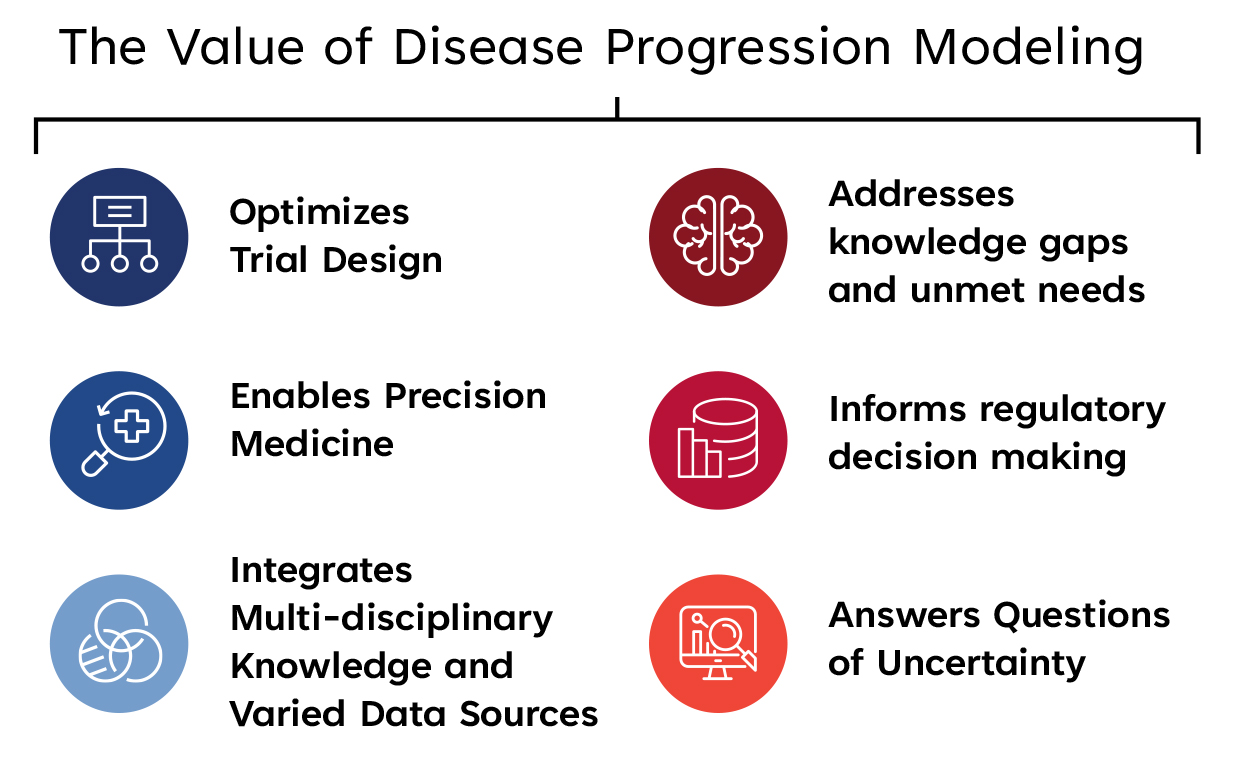
The use of a DPM integrates multi-disciplinary knowledge and data from different sources, including translational, clinical trial, and real world data to:

  • Impact trial efficiency, especially for trials with diseases that progress over a long duration of time, for which running a clinical trial during that period of time is costly and burdensome.
  • Answer questions of uncertainty. It can account for and provide clarity around heterogeneity across patients and at an individual level.
  • Tailor trials towards precision medicine. Recognizing that diseases progress differently, across populations and in different stages within a patient, DPM can address individual factors or covariates affecting progression to enable trial design optimization and tailor trials towards precision medicine (e.g. stratify populations or adapt treatment plans).
  • Address unmet needs and knowledge gaps, including supplementing for a small population size with digital twins in rare disease trials, or stratifying a population for patient enrichment for diseases with heterogeneous phenotypes (e.g. autoimmune and neurodegenerative diseases), or supporting a limited understanding of the disease by modeling disease course for endpoint selection.
  • Inform regulatory decision making. DPM contributes to the totality of understanding of a medical product’s benefits and risks, helping to advance its development and support regulatory decision-making both in premarket product review and post-market product assessment.

CTTI further describes the value of DPM, its current applications, and opportunities for uptake in the following article published in Clinical Pharmacology & Therapeutics called The Potential of Disease Progression Modeling to Advance Clinical Development and Decision Making.

Recommendations Summary

  1. Evaluate if longitudinal data about the disease course is critical to answer a question of interest for medical product development decisions.
  2. Assess the value of using a disease progression model compared with other potential approaches.
  3. Use the most up-to-date understanding of the disease and measure(s) of progression available to inform your disease progression modeling approach.
  4. Determine whether the necessary sources of data are available, relevant and reliable to develop a disease progression model.
  5. Determine whether technological and model resources, as well as the right skill sets, exist or can be obtained to support the disease progression model development and implementation.
  6. Begin using disease progression modeling early on in the medical product development lifecycle to build confidence in the model for later stages of development.
  7. Continually assess the performance and ensure the disease progression model is qualified for the intended application.
  8. Leverage new technology and evolving methods to advance uses of disease progression models.
  9. Disseminate critical insights on disease progression modeling to promote standardized practices and foster confidence.

Recommendations

Future Directions

Ongoing advancements in technology, such as the ability to leverage continuous data from digital health technologies and the potential for synthetic data, coupled with regulatory support and resources (e.g., via FDA’s Quantitative Medicine and Digital Health Centers of Excellence), present significant opportunities for future developments in disease progression modeling (DPM).

While the majority of DPM work has traditionally focused on drug development, these models can also support device development and drug-device combinations. Notable examples include the use of modeling for artificial pancreas systems and brain stimulation treatments for Parkinson’s disease. Therefore, the recommendations within this document are designed to be applicable across various contexts of medical product development.

Moreover, disease progression models can aid in forecasting clinical response trajectories in healthcare settings beyond drug development, offering a framework for integration with clinical practice. This integration can enhance patient care by providing more accurate predictions of disease progression and treatment outcomes.

CTTI encourages consortia and public-private partnerships to actively track these opportunities and monitor how they may improve the quality and efficiency of clinical trials and medical product development. By fostering collaboration and innovation, we can ensure that disease progression modeling continues to evolve and contribute to advancements in healthcare.

Methods

Experts from across the clinical trials ecosystem developed these recommendations following CTTI’s five-step methodology design to ensure the recommendations are actionable, evidence-based, and consensus driven.

Acknowledgements:

Thank you to the experts and key contributors from across the clinical trials ecosystem who helped create this set of recommendations and resources, including the Disease Progression Modeling project team leaders and members, Expert Meeting participants, Recommendations Advisory Committee members, and many others.

Table 1.

Appendix

Examples of DPM use for medical product development decision making:

Regulatory:

  • Goteti, K. Opportunities and Challenges of Disease Progression Modeling in Drug Development – An IQ Perspective. Clin Pharmacol Ther. Feb 18 2023; https://doi.org/10.1002/cpt.2873
  • Disease models listed in Table 2 on FDA’s Division of Pharmacometrics webpage
  • EMA’s qualification responses (based on specific disease areas):
    • Qualification opinion of a novel data driven model of disease progression and trial evaluation in mild and moderate Alzheimer’s disease
    • Qualification Opinion of Islet Autoantibodies (AAs) as Enrichment Biomarkers for Type 1 Diabetes (T1D) Prevention Clinical Trials qualification-opinion- prognostic- covariate-adjustment-procovatm_en.pdf
    • Letter of Support of Model-based Clinical Trial Simulation Platform (CTSP) for Duchenne Muscular Dystrophy letter-support model-based- clinicaltrial-simulation-platform-optimizedesignefficacy-evaluation-studies- parkinsonsdisease_en.pdf
    • Letter of support for “Islet autoantibodies as enrichment biomarkers for type 1 diabetes prevention studies, through a quantitative disease progression model”
    • Letter of support for Model-based CT enrichment tool for CTs in aMCI

DPM used to stratify a population to inform treatment or outcome measures and optimize trial design:

  • Romero, K. et al. Molecular neuroimaging of the dopamine transporter as a patient enrichment biomarker for clinical trials for early Parkinson’s disease. Clin. Transl. Sci. 12, 240-246 (2019)
  • Feng Y, Wang X, Suryawanshi S, Bello A, Roy A. Linking tumor growth dynamics to survival in ipilimumab-treated patients with advanced melanoma using mixture tumor growth dynamic modeling. CPT Pharmacometrics Syst Pharmacol. Nov 2019; 8(11):825–834. doi:10.1002/psp4.12454

DPM used for a rare disease with data paucity:

  • Reetz K, Dogan I, Hilgers RD, et al. Progression characteristics of the European Friedreich’s ataxia consortium for translational studies (EFACTS): A 4-year cohort study. Lancet Neurol. May 2021;20(5):362-372. doi:10.1016/ S1474-4422(21)00027-2

DPM used to link pathophysiology to medical product development decisions:

  • Kaddi, C.D. et al. Quantitative systems pharmacology modeling of acid sphingomyelinase deficiency and the enzyme replacement therapy olipudase alfa is an innovative tool for linking pathophysiology and pharmacology. CPT Pharmacometrics Syst. Pharmacol. 7, 442-452 (2018).

Resources for the use of data for DPM development and implementation:

Examples of DPM used to bridge gaps between early and late stage development phases to inform early go/no go decisions:

  • Wang, Y. et al. Elucidation of relationship between tumor size and survival in non-small-cell lung cancer patients can aid early decision making in clinical drug development. Clin. Pharmacol. Ther. 86, 167-174 (2009).
  • Sheng Y, Teng SW, Wang J, Wang H, Tse AN. Tumor growth inhibition-overall survival modeling in non-small cell lung cancer: A case study from GEMSTONE-302. CPT Pharmacometrics Syst Pharmacol. 2024 Mar;13(3):437-448. doi: 10.1002/psp4.13094. Epub 2023 Dec 21. PMID: 38111189; PMCID: PMC10941555.

Example resources to assess the performance of a DPM:

  • General Principles for Model-Informed Drug Development. ICH Harmonised Guideline
  • Toward Good Simulation Practice
  • EFPIA MID3 Workgroup (2016). Good practices in model-informed drug discovery and development (MID3): Practice, application and documentation. CPT: Pharmacometrics & Systems Pharmacology (5) 93-122.doi: 10.1002/psp4.12049
  • Musuamba et al. 2021 Scientific and regulatory evaluation of mechanistic in silico drug and disease models in drug development: Building model credibility CPT-PSP (10), 804
  • Assessing the Credibility of Computational Modeling and Simulation in Medical Device Submissions Guidance for Industry and Food and Drug Administration Staff.
  • ASME’s V&V 40 Assessing Credibility of Computational Modeling through Verification and Validation: Application to Medical Devices

Machine Learning in DPM used to enhance precision medicine:

  • Terranova N, Venkatakrishnan K. Machine learning in modeling disease trajectory and treatment outcomes: An emerging enabler for model-informed precision medicine. Clin Pharmacol Ther. Dec 17 2023; doi:10.1002/cpt.3153

Collaborative Groups and Case Study Exchanges:

References

  1. S, Nicholas T, Azer K, Corrigan BW. Role of disease progression models in drug development. Pharm Res. Aug 2022;39(8): 1803-1815. doi:10.1007/s11095-022-03257-3
  2. Starling, S. The Potential of Disease Progression Modeling to Advance Clinical Development and Decision Making Clin Pharmacol Ther. Oct 15 2024; https://doi.org/10.1002/cpt.3
  3. Madabushi R, Benjamin J, Zhu H, Zineh I. The US Food and Drug Administration’s model-informed drug development meeting program: From pilot to pathway. Clin Pharmacol Ther. Mar 6 2024; doi:10.1002/cpt.3228
  4. Barrett, J.S., Betourne, A., Walls, R.L. et al. The future of rare disease drug development: the rare disease cures accelerator data analytics platform (RDCA-DAP). J Pharmacokinet Pharmacodyn 50, 507–519 (2023). https://doi.org/10.1007/s10928-023-09859-7
  5. Sheng Y, Teng SW, Wang J, Wang H, Tse AN. Tumor growth inhibition-overall survival modeling in non-small cell lung cancer: A case study from GEMSTONE-302. CPT Pharmacometrics Syst Pharmacol. 2024 Mar;13(3): 437-448. doi: 10.1002 psp4.13094. Epub 2023 Dec 21. PMID: 38111189; PMCID: PMC109
  6. Corneli A, Hallinan Z, Hamre G, et al. The clinical trials transformation initiative: Methodology supporting the mission. Clin Trials. Feb 2018;15 (1_suppl):13-18. doi:10.1177/1740774518755054.” psp4.13094. Epub 2023 Dec 21. PMID: 38111189; PMCID: PMC10941555.
  7. Aghamiri SS, Amin R, Helikar T. Recent applications of quantitative systems pharmacology and machine learning models across diseases. J Pharmacokinet Pharmacodyn. 2022 Feb;49(1):19-37. doi: 10.1007/s10928-021-09790-9. Epub 2021 Oct 20. PMID: 34671863; PMCID: PMC8528185.
  8. Myles, Puja, Mitchell, Colin, Redrup Hill, Elizabeth, Foschini, Luca and Wang, Zhenchen (2024, June 1). High-fidelity synthetic patient data applications and privacy considerations. In the Journal of Data Protection & Privacy, Volume 6, Issue 4. https://doi.org/10.69554/LQOM5698.


CTTI to Launch New Recommendations on Disease Progression Modeling in Free Public Webinar 

CTTI News | June 10, 2025

Topics Included: Innovative Trials

The Clinical Trials Transformation Initiative (CTTI) will host a free public webinar on Tuesday, July 8, to introduce new recommendations for using disease progression modeling (DPM) to improve medical product development. 

The webinar will include a welcome from Sara Calvert, CTTI director of projects; a keynote presentation from Cynthia J. (CJ) Musante, vice president of scientific research at Pfizer; a project overview from Lindsay Kehoe, CTTI senior project manager; and a panel discussion moderated by Kehoe featuring perspectives on the potential real-world application and impact of the recommendations. Panelists include Karthik Venkatakrishnan from EMD Serono, Tiffany Westrich-Robertson from AiArthritis, Theo Zanos from Northwell Health, and Efthymios Manolis from the European Medicines Agency. 

A disease progression model is a mathematical model that quantitatively describes the time course or trajectory of a disease. By integrating multi-disciplinary knowledge and data from different sources—including translational, clinical trial, and real-world data—DPM can improve trial design, answer questions of uncertainty, and support regulatory decisions. 

CTTI’s new recommendations aim to guide medical product development decision makers—such as clinical, regulatory, and innovation leaders—in identifying when DPM can offer unique value, what foundational elements are required, and how to communicate effectively with modeling experts to support its implementation. 

The 60-minute webinar will begin at 12:00 PM EDT. To attend, please take a moment to register 

We encourage you to share this announcement with colleagues or others in your network who may be interested in attending.

Recent CTTI Publication Reviews Current Applications and Future Opportunities for Disease Progression Modeling

CTTI News | October 17, 2024

Topics Included: Innovative Trials, Regulatory Submissions + Approvals

new CTTI publication, published in Clinical Pharmacology & Therapeutics, reviews current applications of disease progression modeling (DPM) and opportunities to advance the awareness and value of DPM in clinical trials. Use of modeling and simulation during drug development, otherwise known as model-informed drug development (MIDD), can help researchers make informed decisions when planning and executing clinical trials. DPM is one form of MIDD that integrates multiple types of data from various sources – including translational, clinical trial, and real-world data – to optimize trial design and execution and support regulatory decision-making. The potential of DPM has yet to be fully realized.  

To advance the use of disease progression modeling for decision making in clinical trials and medical product development, CTTI assembled a diverse project team, conducted a scoping literature review to identify current DPM applications, and shared these results at a multi-partner Expert Meeting with representatives from academia, data/tech organizations, government, the medical product industry, patients, and trade/professional organizations. They discussed the value of disease progression modeling and identified key areas that need to be addressed to incorporate DPM approaches more effectively in medical product development and regulatory decision-making. 

The paper presents the scoping review results, opportunities to increase uptake identified at the Expert Meeting, and proposes key questions that medical product developers and regulators may use to inform clinical development strategy and optimize trial design with disease progression models.

CTTI Holds Meeting to Discuss Strategies for Advancing the Use and Acceptance of Disease Progression Modeling (DPM) in Clinical Trial Design & Decision Making

The Clinical Trials Transformation Initiative (CTTI) held a multi-stakeholder expert meeting on March 6 to discuss strategies for advancing the use and acceptance of disease progression modeling (DPM) in clinical trial design and decision making. Meeting attendees discussed DPM and its current applications; explored opportunities, barriers, and best practices for advancing the use of DPM in clinical trial decision making; and proposed relevant metrics for monitoring and evaluating the recognition, value, and consistent use of DPM. CTTI will be using the ideas generated during this meeting and collecting case examples of DPM application in order to identify and catalog examples of how DPM can provide value for clinical trials – with the ultimate goal of developing and disseminating recommendations that address DPM best practices. 

The maturity and potential impact of model-informed drug development (MIDD) is recognized, but knowledge sharing and clear regulatory expectations are needed to realize its widespread use. FDA’s paired meeting program and the Fit-for-Purpose initiative are examples of programs that foster engagement and transparent communication but additional communication and pre-competitive collaboration is needed between the modeling industry, regulatory agencies, and the clinical community to advance consistent application of MIDD. 

During the meeting, attributes that allow for a successful application of DPM in a given context were discussed, leveraging the results from the CTTI DPM project team scoping review and expert panel presentations.  

  • Meeting attendees also discussed essential next steps for advancing the recognition,
    value, and use of DPM approaches, including the need to:
    ► Establish best practices and provide illustrative case examples.
    ► Develop a common language for disease progression modeling.
    ► Highlight the value and impact of DPM for a variety of stakeholders.
    ► Facilitate communication across stakeholders.
    ► Create metrics to monitor the changes in DPM acceptance and use within organizations and across the clinical trials enterprise (CTE). 

Overall, meeting attendees highlighted that the benefit of CTE-wide adoption of DPM would be faster, higher-quality drug development programs, and more diverse clinical trials. 

Disease Progression Modeling Expert Meeting

MEETING OBJECTIVES:

  • Discuss disease progression modeling (DPM) and its current applications 
  • Explore opportunities, barriers, and best practices for advancing the use of disease progression modeling to aid in decision making 
  • Brainstorm relevant metrics to monitor and evaluate the recognition, value and consistent use of disease progression modeling  

Meeting Location: Mayflower Hotel, Washington, D.C.

Meeting Summary

Meeting Agenda

List of Meeting Attendees

Full Presentation Set            

Meeting Materials:

The views and opinions expressed in this presentation are those of the individual presenter and should not be attributed to the Clinical Trials Transformation Initiative, or any organization with which the presenter is employed or affiliated.

New CTTI Project Aims to Promote the Use of Disease Progression Modeling to Advance Trial Design and Decision Making

Modeling and simulations are powerful tools that can be leveraged to inform clinical trial design, support regulatory decision making, and accelerate the process of bringing treatments to patients. Despite the benefits of these methods, their use is still not widely accepted among sponsors, investigators, and regulators. Recently, there has been growing interest across the clinical trials ecosystem in advancing the use of disease progression modeling to improve clinical trial quality and efficiency and inform regulatory decision making. Disease progression modeling leverages data from a variety of sources, improving trial diversity and combining many different models to help inform decision making. 

To promote these methods, CTTI has started a new project engaging a variety of stakeholders and experts in the development of recommendations and resources for the application of disease progression modeling in clinical trials. Through this project, CTTI will generate case studies detailing successful applications of disease progression modeling, a framework for the execution of disease progression modeling in clinical trials, a set of recommendations for the implementation of disease progression modeling in clinical trials, and a review paper detailing relevant disease progression modeling applications. This project aims to improve trial and clinical development efficiency by increasing the recognition, value, and consistent use of disease progression modeling. CTTI’s work in this area will also help to advance the broader application of modeling and simulation for trial design and regulatory decision making. 

To generate recommendations and resources supporting the application of disease progression modeling in clinical trials, CTTI will utilize a variety of iterative evidence generating strategies—including a scoping review assessing the landscape of disease progression modeling applications and an expert meeting discussing the barriers to disease progression modeling application and avenues for advancement. 

Through this work, CTTI will create recommendations and resources for designing clinical trials with a quality approach that maximally leverages available data—in alignment with CTTI’s Transforming Trials 2030 vision.