Recording of Hybrid Public Workshop Now Available: AI in Drug and Biological Product Development v2

CTTI News | September 23, 2024

Topics Included: Data Collecting and Reporting, Ensuring Quality, Innovative Trials, Patient Engagement, Recruitment, Regulatory Submissions + Approvals, Safety, Site Planning

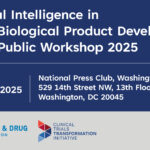
The recording for the hybrid public workshop on AI in Drug and Biological Product Development convened and hosted by the U.S. Food and Drug Administration (FDA) and Clinical Trials Transformation Initiative (CTTI), held August 6, is now available. Over 9,000 registrants from diverse backgrounds and perspectives joined to explore the responsible use of AI in drug development. 

During the workshop, we learned from experts as they discussed guiding principles for the responsible use of AI in the development of safe, effective, and high-quality drugs. Drawing on real case examples, experts discussed their rationale for particular approaches, shared their methods for evaluating success, recounted challenges and obstacles, explored options for scaling and wider applicability, and outlined considerations for moving forward. Presentations can also be found here. 

Recent Publication Reviews How CTTI’s Digital Health Trial Hub Can Unlock the Potential of Digitalizing Trials

A new CTTI publication, published in Nature Reviews Bioengineering, reviews opportunities for and challenges to using digital health technologies in clinical trials and highlights CTTI’s Digital Health Trials (DHTs) Hub. Digital health technologies have the potential to transform evidence generation in clinical trials, from trial design and participant screening to data capture and analysis. However, digital health technologies introduce new challenges, including concerns around data protection and data quality. The wide variety of available technologies requires that sponsors carefully identify meaningful measures, select and test appropriate technologies for capturing these measures, and train site staff and participants to properly use the selected technologies.

CTTI’s DHT Hub includes tools and recommendations for developing novel endpoints, planning decentralized trials, selecting and testing digital health technologies, managing data, supporting sites, and interacting with regulators. These resources support the effective implementation of DHTs to bring therapies to patients more quickly and efficiently, aligning with CTTI’s Transforming Trials 2030 vision.

CTTI and FDA Share Strategies for Improving Timely, Accurate, and Complete Registration and Reporting of Summary Results Information for Applicable Clinical Trials on ClinicalTrials.gov

Timely, accurate, and complete registration and reporting of summary results information for applicable clinical trials on ClinicalTrials.gov allows access to current research and evidence for all partners in the clinical trials enterprise, including patients, providers, sponsors and investigators, regulators, payers, and health system leaders. Despite the regulatory requirements for applicable clinical trials and the importance of fostering transparency while increasing knowledge of potential new treatments in development, multiple publications have reported gaps in clinical trial registration and results information submission to the data bank.  

To address this issue, the Clinical Trials Transformation Initiative (CTTI) collaborated with the Food and Drug Administration (FDA) on a project to understand the barriers to timely, accurate, and complete registration and reporting of summary results information for applicable clinical trials on ClinicalTrials.gov. The project involved in-depth interviews and a survey to identify the range of barriers and their salience by type of stakeholder, root causes influencing barriers, and potential solutions and helpful practices to implement moving forward. After the relevant themes were assessed, CTTI surveyed 92 individuals who represented 84 unique organizations and condensed this information into a report containing strategies and recommendations for improving registration and reporting. 

Some of the strategies include: 

  • Use a centralized/dedicated approach to meeting ClinicalTrials.gov requirements  
  • Take a proactive, rather than reactive, approach to complying with ClinicalTrials.gov regulatory requirements 
  • Escalate to upper levels of leadership for PIs/study teams that are non-responsive to the administrative unit’s communication about compliance  
  • Inform PIs/study teams  
    • about the possibility of civil money penalties for non-compliance with ClinicalTrials.gov regulatory requirements;  
    • that submitting results information on ClinicalTrials.gov is separate from publishing results; and 
    • that, per ICMJE, reporting results information on ClinicalTrials.gov does not preclude publishing results in journals 
  • Provide education, resources, guidance, and support about meeting ClinicalTrials.gov requirements to PIs/study teams and other research personnel 

See the full report for a complete list of strategies. 

When describing challenges with registering and reporting summary results information from applicable clinical trials, respondents cited several major challenges: 

  • A lack of understanding on the part of the Principal Investigator (PI) and their study team regarding  
    • the type of trial that must be registered,  
    • which trial results must be submitted,  
    • and when they should be registered.  
  • Administrative groups also reported challenges relating to non-responsive PIs and study teams, which hinders both timely registering and reporting of results.  
  • For reporting, PIs and study teams responding to the survey also expressed concerns about waiting until all data are analyzed before reporting results information on ClinicalTrials.gov to prevent discrepancies between ClinicalTrials.gov data and published results. 

For more information, see CTTI’s Project page: Challenges Meeting U.S. ClinicalTrials.gov Reporting Requirements. 

CTTI Holds Meeting to Discuss Strategies for Advancing the Use and Acceptance of Disease Progression Modeling (DPM) in Clinical Trial Design & Decision Making

The Clinical Trials Transformation Initiative (CTTI) held a multi-stakeholder expert meeting on March 6 to discuss strategies for advancing the use and acceptance of disease progression modeling (DPM) in clinical trial design and decision making. Meeting attendees discussed DPM and its current applications; explored opportunities, barriers, and best practices for advancing the use of DPM in clinical trial decision making; and proposed relevant metrics for monitoring and evaluating the recognition, value, and consistent use of DPM. CTTI will be using the ideas generated during this meeting and collecting case examples of DPM application in order to identify and catalog examples of how DPM can provide value for clinical trials – with the ultimate goal of developing and disseminating recommendations that address DPM best practices. 

The maturity and potential impact of model-informed drug development (MIDD) is recognized, but knowledge sharing and clear regulatory expectations are needed to realize its widespread use. FDA’s paired meeting program and the Fit-for-Purpose initiative are examples of programs that foster engagement and transparent communication but additional communication and pre-competitive collaboration is needed between the modeling industry, regulatory agencies, and the clinical community to advance consistent application of MIDD. 

During the meeting, attributes that allow for a successful application of DPM in a given context were discussed, leveraging the results from the CTTI DPM project team scoping review and expert panel presentations.  

  • Meeting attendees also discussed essential next steps for advancing the recognition,
    value, and use of DPM approaches, including the need to:
    ► Establish best practices and provide illustrative case examples.
    ► Develop a common language for disease progression modeling.
    ► Highlight the value and impact of DPM for a variety of stakeholders.
    ► Facilitate communication across stakeholders.
    ► Create metrics to monitor the changes in DPM acceptance and use within organizations and across the clinical trials enterprise (CTE). 

Overall, meeting attendees highlighted that the benefit of CTE-wide adoption of DPM would be faster, higher-quality drug development programs, and more diverse clinical trials.