


The need for better, more efficient clinical trials has never been clearer. CTTI unites experts from across the clinical trials enterprise—including clinicians, ethics board representatives, healthcare system leaders, patients, payors, regulators, and sponsors—to identify challenges, exchange ideas, and develop actionable solutions. Through a collaborative, research-driven approach, CTTI creates evidence-based recommendations and tools that drive real change. These solutions are designed to enhance the quality and efficiency of trials today while advancing a bold vision for the future: Transforming Trials 2030.
Antibacterial Drug Development
Increasing bacterial resistance coupled with decreasing research on new antibacterial drugs is creating a crisis that could disproportionately impact our most vulnerable populations, including children and the seriously ill.
CTTI has created approaches for streamlining antibacterial drug development that will help you design clinical trials that better assess the efficacy and safety of new antibacterial drugs and inform clinical trial planning, recruitment, enrollment, and feasibility. Use CTTI’s recommendations and resources to help combat this complex public health concern.
Challenges Meeting U.S. ClinicalTrials.gov Reporting Requirements
Timely, accurate, and complete registration and reporting of summary results information for applicable clinical trials on ClinicalTrials.gov is an important part of providing patients, providers, researchers, and the public with access to information
Clinical Trials Issues Related to COVID-19
The COVID-19 pandemic turned our world upside down. And, within the clinical trials community, nearly every aspect of research experienced unprecedented disruptions.
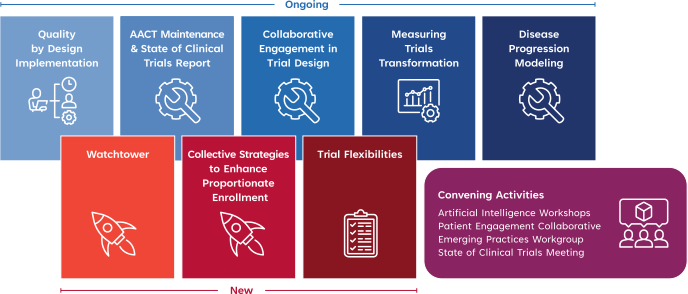
Collaborative Engagement in Clinical Trial Design
Engaging the broad range of stakeholders from the earliest stages of trial design is increasingly recognized as fundamental to planning and conducting high quality clinical trials.
Collective Strategies to Enhance Proportionate Enrollment
The Collective Strategies to Enhance Proportionate Enrollment project focuses on improving accountability, clarity, and communication across clinical trials partner groups to support more effective recruitment, enrollment, and retention practices. This effort seeks to understand and address the challenges, expectations, and needs of each group involved in clinical trials, including contract research organizations, patient organizations, sites, and sponsors.
CTTI Publication Provides Recommendations for Disease Progression Modeling in Medical Product Development
Disease progression modeling (DPM) has the potential to support greater efficiency and better decision-making in clinical development, yet it remains underutilized compared with more established model-informed drug development approaches.
Data Monitoring Committees
Data monitoring committees (DMCs) work closely with investigators and sponsors to monitor trial conduct and safety, assess risks and benefits, and make recommendations to protect the participants of clinical trials.
Developing Novel Endpoints
CTTI has described steps for selecting and developing novel endpoints from digital health technologies.
Digital Health Trials
Digital health trials are here to stay. Use CTTI’s broad suite of recommendations and resources to design and run a successful, fit-for-purpose digital health trial that meets your research goals.
Diversity in Clinical Trials
The underrepresentation of diverse populations in clinical trials creates knowledge gaps about the risks and benefits of drugs and devices and undermines public trust in research.
Electronic Healthcare Data
Using electronic health record (EHR) data and other real-world data (RWD) sources for clinical research holds tremendous promise.
Embedding Clinical Trials into Clinical Practice
When research data is collected separately from a clinical care setting, studies may produce results that do not reflect the real-world performance of medical products in the populations that will use them.
Informed Consent
The informed consent process can often be burdensome and lacks giving prospective trial participants the information they need to aid in their decision to participate.
Informing ICH E6 Renovation
Our work to improve the quality and efficiency of clinical trials goes beyond the U.S. borders.
Interacting With Regulators
Using modeling and simulations, researchers can make informed decisions when planning and executing clinical trials. In particular, disease progression modeling leverages multiple types of data from various sources to inform trial design and support regulatory decision making.
Investigator Community
Knowledgeable and experienced site investigators are vital to conducting efficient, high-quality clinical trials.
Investigator Qualification
By itself, redundant Good Clinical Practice (GCP) training too often creates an unnecessary burden for site teams and limits the opportunity for more valuable, protocol-specific learning and preparation.
Large Simple Trials
Large simple trials (LSTs) typically answer only one or two questions in a broader patient population and are generally more efficient and less expensive than other large randomized controlled trials.
Managing Data
Digital health technologies have fundamentally changed when, where, and how data can be collected.
Master Protocol Studies
The value of master protocol studies has become clear: we need agile clinical trials that foster collaboration to address major public health threats and ongoing research challenges.
Measuring Trials Transformation
Launched in 2021, CTTI’s Transforming Trials 2030 vision outlines five key pillars for how clinical trials should be performed by 2030.
Optimizing Data Quality and Flexibility in Clinical Trials
CTTI’s project, Optimizing Data Quality and Flexibility in Clinical Trials, aims to enhance patient and site access, improve participant satisfaction, and facilitate the use of real-world data through flexible operational approaches in trial design and conduct.
Original Digital Health Trials Projects
Throughout 2015-2019, CTTI worked in four key areas to identify and address the challenges of planning for and conducting FDA-regulated clinical trials that use digital health technologies
Patient Engagement Collaborative
The Patient Engagement Collaborative (PEC) is a joint project between the U.S. Food and Drug Administration (FDA) and the Clinical Trials Transformation Initiative (CTTI).
Patient Group Engagement
Patient groups have increasingly been recognized as equal partners in clinical research, and their collaboration can lead to better research questions and more meaningful, feasible studies.
Planning Decentralized Trials
Your approach to running a decentralized clinical trial doesn’t have to be all or nothing. Decentralized clinical trials sit on a wide spectrum – they can be completely virtual, partially decentralized with hybrid approaches, or very similar to traditional “brick and mortar” trials.
Pregnancy Testing
Pregnant women have traditionally been excluded from clinical research – however, until now, there were no guidelines for planning for pregnancy testing in clinical trials.
Quality By Design
Avoiding errors, collecting data that is fit-for-purpose, and reducing patient burden are just a few of the many benefits of applying Quality by Design (QbD)—an approach that focuses resources on the errors that matter to decision making during a trial.
Real-World Data
Real-world data (RWD) and real-world evidence (RWE), collected through the routine delivery of health care, are potentially powerful tools for enhancing the quality and efficiency of clinical trials.
Recruitment
In order to ensure your trial has adequate recruitment, you have to plan for it. It sounds simple, but a primary reason why clinical trials stop early is because of a failure to enroll enough participants.
Registry Trials
The primary purpose of registries has traditionally been to collect data to better understand long-term trends in specific populations.
Safety Reporting
CTTI’s work will help you improve the quality and efficiency of safety reporting, reduce irrelevant reports, and increase adherence to FDA requirements for clinical trials conducted under an investigational new drug application (IND).
Selecting and Testing a Digital Health Technology
There are many digital health technologies in the marketplace—how do you choose the best one for your trial? And after you’ve selected the candidate technology for your trial, how do you prepare it for use in the field?
Single IRB
For nearly a decade, CTTI has championed the adoption of single IRBs (sIRBs) for multicenter clinical trials in an effort to streamline and optimize study execution.
State of Clinical Trials
One of the initial steps to improving clinical trials is to document the current state of clinical trials in order to track changes over time.
Study Start-Up
Study start-up (SSU) for randomized controlled trials is usually a long and costly process that can cause significant delays.
Supporting Sites
When planning clinical trials that use digital health technologies, use CTTI’s recommendations and resources to develop a robust digital health technology management plan.
Using Disease Progression Modeling to Advance Trial Design and Decision Making
Using modeling and simulations, researchers can make informed decisions when planning and executing clinical trials. In particular, disease progression modeling leverages multiple types of data from various sources to inform trial design and support regulatory decision making.
Watchtower
CTTI’s Watchtower Project addresses growing concerns about the readiness and capacity of U.S. clinical trials sites to generate timely and impactful clinical evidence, particularly during public health emergencies (PHEs).